How does medical tourism work for cosmetic procedures? This end-to-end guide covers costs, risks, credentials and aftercare. Plan your journey confidently.
Understanding how medical tourism works for cosmetic procedures is the first step any prospective patient should take, because the journey looks far simpler in a brochure than it turns out to be in practice. An increasing number of UK patients travel abroad for cosmetic surgery each year, and the primary reason is straightforward: procedure costs at reputable international clinics can be substantially lower than equivalent UK private fees, with savings of this magnitude documented across procedures such as breast augmentation, rhinoplasty, and abdominoplasty in destinations including Turkey, Poland, and Spain. That gap is real and the savings are genuine, but they depend entirely on choosing the right procedure and the right clinic. Most first-timers discover the critical details, surgeon verification, precise travel timing, post-operative logistics, specialist insurance, only after they have already committed.
This guide covers every stage of the process: how a well-structured trip is designed, what plastic surgery overseas genuinely costs when you account for the full journey, what the published complication data actually shows, and how to verify a clinic and surgeon before you spend a penny. The patients who come through medical tourism with excellent results tend to have one thing in common: they treated the planning as seriously as the procedure itself. Clinics that share that philosophy make that preparation considerably easier. Prof. Dr. Ufuk Bilkay’s practice in Izmir is one example, where coordination is managed as a clinical service rather than a booking formality.
How medical tourism works for cosmetic procedures: the full journey
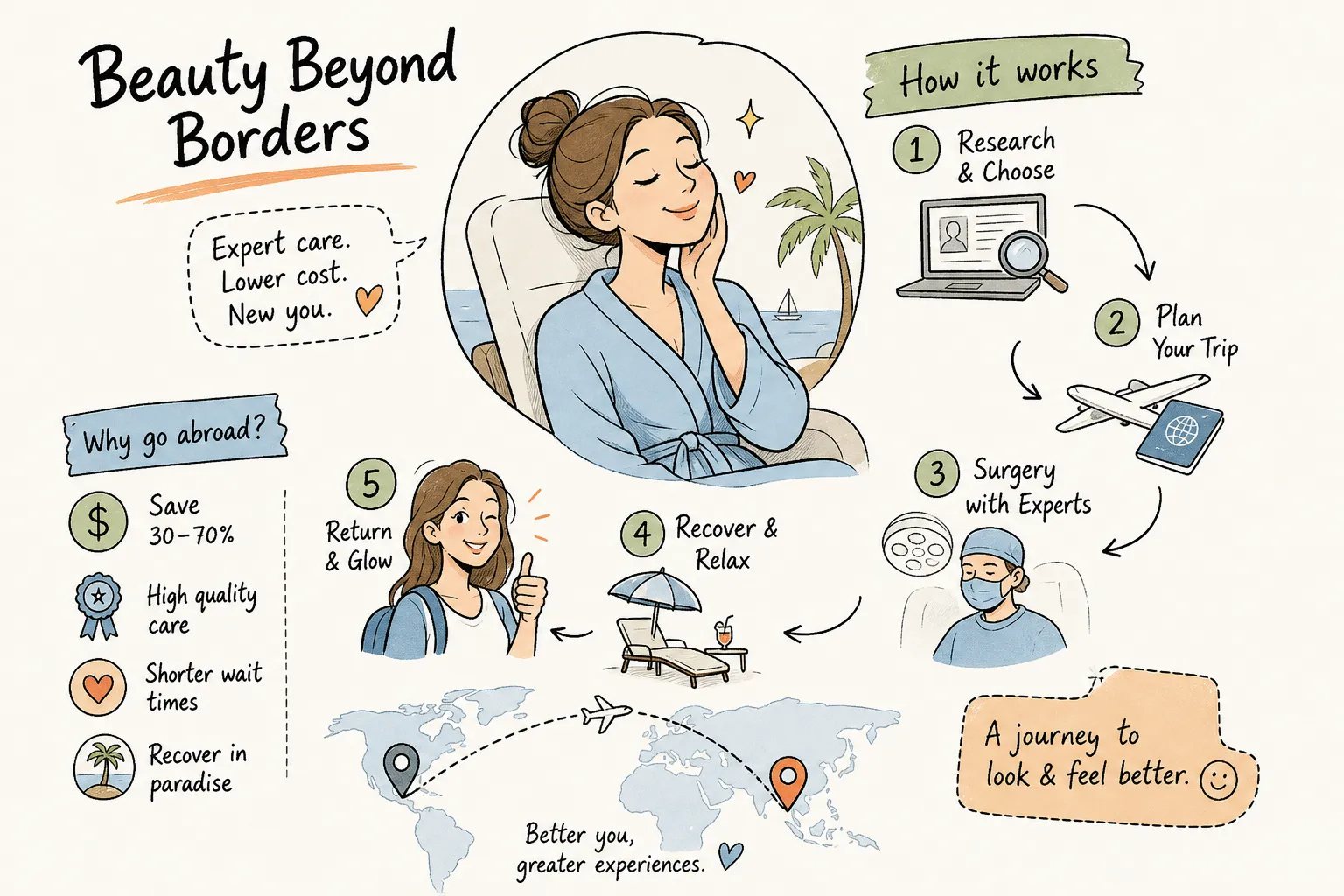
A properly managed cosmetic surgery trip begins several months before you board a flight. The process opens with independent research into the surgeon’s credentials and published outcomes, followed by a virtual consultation, typically by video, where you submit photographs, discuss your goals, and receive a personalised treatment plan and written quote. Many clinics serving international patients offer these consultations in English across multiple time zones, so the initial stages feel no different from a domestic appointment. This is also the stage at which you should establish who your named point of contact is and how quickly they respond to questions.
Once you have confirmed your booking, a well-coordinated clinic takes over the logistical layer: airport transfers, accommodation close to the clinic, pre-operative blood tests and assessments arranged locally, and a daily schedule so you are never navigating alone. There is a meaningful difference between a clinic that provides genuine concierge coordination, one that anticipates every moving part of your stay, and one that simply hands you a date and a procedure code and leaves you to manage the rest.
Your in-country week typically moves through a pre-operative assessment on arrival, the procedure itself, a period of supervised recovery in a clinic or nearby hotel, and a formal post-operative review with your surgeon before you are cleared to travel. That departure briefing matters enormously. It should cover wound care protocols, the warning signs that require immediate attention, and a clear contact number for your surgical team once you are home. A thorough briefing is what separates a safe departure from a premature one.
What cosmetic surgery abroad actually costs in 2026
Procedure fees: UK versus popular destinations
UK private fees for the most commonly sought procedures in 2026 sit at roughly £3,500 to £8,000 for breast augmentation, £4,500 to £8,000 or more for rhinoplasty, and £5,000 to £9,000 for abdominoplasty (figures drawn from current UK private clinic pricing data). By comparison, medical tourism destinations quote lower procedure fees: breast augmentation in Turkey, for example, is frequently listed between £2,500 and £4,500, and rhinoplasty in Turkey runs approximately €2,850 to €4,300. Poland and Spain offer comparable savings on breast augmentation, with quoted ranges of £2,500 to £4,000 and £3,500 to £5,500 respectively. These figures are genuine starting points, but they require careful interpretation.
The headline price almost never tells the full story. Return flights, a week or more of accommodation near the clinic, pre-operative tests, compression garments, prescribed medications, and any aftercare consultations you need from your GP once home all add to the real cost of medical travel for cosmetic procedures. A well-priced procedure combined with flights and a hotel in a major city can narrow the headline saving considerably, particularly for shorter-haul European destinations. The honest question is not “how much cheaper is the procedure?” but “what is the total cost of the entire trip?”
When the savings genuinely make sense
The financial case for plastic surgery overseas is strongest when several conditions align: the procedure is well-established and carries a manageable recovery period, the surgeon’s credentials are fully verifiable, and you have the flexibility to remain in-country long enough for a safe recovery. If any of those conditions cannot be met, the financial case weakens considerably, and the risk profile, discussed next, shifts accordingly.
The real complication risk: what the research shows
The published evidence on cosmetic tourism complications is worth reading carefully, because it neither condemns the practice wholesale nor lets it off lightly. A 2024 BAPRAS survey found a 16.5% complication rate among UK patients who had cosmetic surgery abroad, with 8.7% requiring further treatment after returning home (BAPRAS, 2024). By contrast, a large Scottish NHS review found that roughly 3% of patients who had cosmetic procedures domestically presented with a complication. A 2025 UK-wide analysis titled “Beauty Abroad, Burden at Home” documented the growing NHS burden from overseas cosmetic complications, noting that between 63% and 83% of complication presentations in some units were linked to surgery performed abroad (UK-wide analysis, 2025).
The complications that appear most frequently in published case series are infection, cited in approximately 45% of cases, and wound dehiscence in around 43% (figures drawn from published rapid reviews and cohort studies). Flying home too early disrupts healing, unfamiliar bacterial environments increase infection risk, and patients who develop problems after returning to the UK often cannot access the original surgeon for timely intervention, a structural vulnerability inherent to cosmetic surgery aftercare abroad. In one published cohort, 53% of patients with complications required emergency admission, and 70% needed corrective surgery.
This data is not an argument against medical tourism; it is an argument for doing it properly. Higher-complexity procedures with longer recovery periods carry more travel-specific risk than shorter, lower-complexity ones. The risk profile is different for a rhinoplasty than for a full abdominoplasty combined with liposuction. Assess each procedure on its own terms, and assess each clinic by the specific protections it puts in place.
How to verify a clinic and surgeon before you book
Verification works on two separate levels: the facility and the individual surgeon. For the facility, Joint Commission International (JCI) accreditation is the most widely recognised international standard, covering infection control, emergency protocols, and facility safety. Verify accreditation for the specific building where your procedure will happen, not for a parent hospital group that may not include your clinic. Other credible schemes include Temos and ISQua-member national bodies. The key question is whether the accreditation involves an onsite survey and a defined renewal cycle, those are the marks of a genuine quality standard, not a marketing badge.
For the surgeon, the check is two-layered. Confirm current registration with the destination country’s national medical council, and verify that the specialty listed matches plastic or aesthetic surgery specifically, not a general or adjacent field. Ask for the surgeon’s full legal name, registration number, and specialist title, then cross-reference those details on the official national register rather than relying on clinic materials. Fellowship training from internationally recognised institutions provides an additional, independently verifiable quality signal: Prof. Dr. Ufuk Bilkay’s Emory University fellowship, for instance, is a credential that patients can verify directly through Emory’s own published records.
Four questions that reveal how prepared a clinic really is
These four questions are particularly useful because they expose structural weaknesses that no brochure will volunteer. Ask what happens if you develop a complication after returning home, the answer reveals whether the clinic has a documented aftercare pathway or is simply hoping you won’t need one. Ask who your named point of contact is throughout the process. Ask whether the operating surgeon will personally perform your procedure. Ask whether you can speak with a previous international patient. Clinics with robust systems answer all four without hesitation.
Post-op care, insurance, and your rights if something goes wrong
How long to stay in-country
BAAPS guidance recommends staying at least one to two weeks after surgery for most major cosmetic procedures, and up to four weeks for higher-risk operations or long-haul travel. For rhinoplasty, the minimum is generally one week before flying; for abdominoplasty, BAAPS advises a minimum of seven to ten days in most cases, and ten to fourteen days for combination procedures. Before you depart, your surgeon should carry out at least one in-person post-operative review, with sutures and any drains formally addressed. Remote follow-up by video at the one-to-two-week and six-week marks is standard practice once you are home.
Specialist insurance for medical travel
Ordinary travel insurance typically excludes planned elective surgery and its complications entirely. You need a specialist medical tourism policy that explicitly covers post-operative complications, corrective surgery, and at least twelve months of follow-up cover. Formedi Medical Travel Insurance is one policy that explicitly includes corrective surgery within twelve months of the original treatment (verify current policy wording directly with the insurer before purchase). Medical repatriation cover is equally important: if you need intensive care or specialist intervention whilst still abroad, you need to know the cost of getting home is covered.
If complications arise after you return to the UK, the NHS must provide emergency and urgent treatment and cannot lawfully refuse on the grounds that your surgery took place overseas. Non-urgent revision of a poor cosmetic outcome is generally not NHS-funded. Legal recourse against an overseas clinic is possible but complex; the most practical position comes from documented contracts, a UK-based facilitator who marketed the procedure, or a claim under the Package Travel and Linked Travel Arrangements Regulations 2018. Seek a specialist solicitor early, because limitation periods vary by country and may be shorter than the UK’s standard three-year window.
Making the decision with confidence
Medical tourism for cosmetic surgery is not inherently reckless, and it is not inherently safe. Understanding how medical tourism works for cosmetic procedures, and committing to every stage of the preparation, is what determines the outcome. That means researching the surgeon as rigorously as the procedure, choosing an accredited facility, budgeting for the full trip rather than the headline procedure fee, and arranging specialist insurance before you travel. The patients who experience the best outcomes are those who brought the same seriousness to every stage of the process as they did to the original decision.
The complexity that concerns first-timers is real, but it becomes manageable when the clinic treats logistics as part of the clinical service. At Prof. Dr. Ufuk Bilkay’s practice in Izmir, the patient journey is structured so that every stage, from the first English-language virtual consultation through to the six-week post-operative check-in, is handled with the same rigour as the surgery itself. That structure reflects Dr. Bilkay’s extensive surgical experience and Emory University fellowship training, together with a considered approach to the full patient pathway.
If you are considering cosmetic surgery abroad, the most useful next step is a virtual consultation: not a commitment, but a conversation that gives you a clear picture of what your specific journey would involve, what the realistic costs are, and whether the fit is right. That conversation is often where a genuinely informed decision begins.
Book a Consultation
It’s easy and free!