Breast reduction explained for UK patients: NHS eligibility, surgical techniques, risks, recovery timeline, and private costs. Know what to ask before you decide.
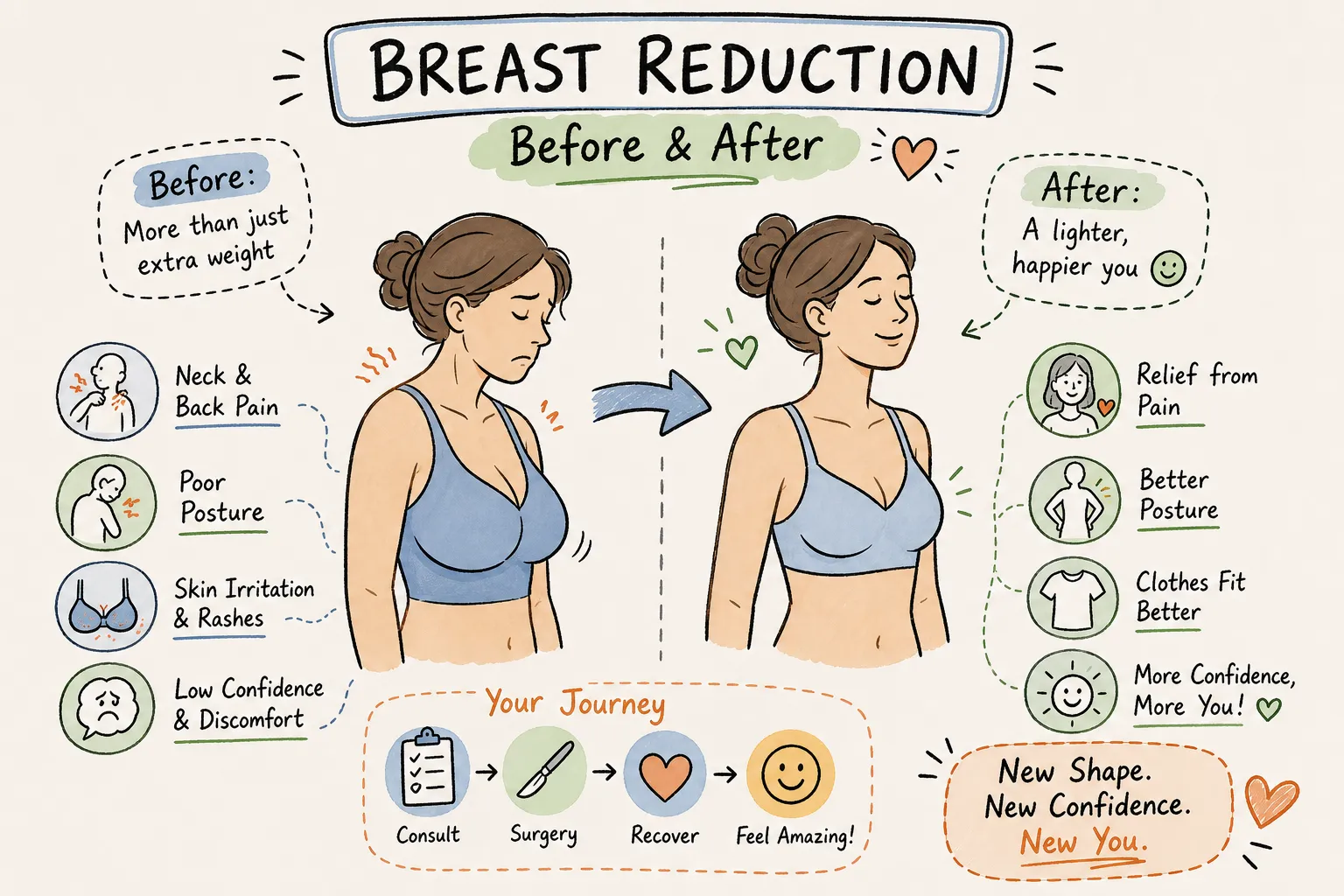
For many women, breast reduction is not an aesthetic concern. It is a daily physical burden: chronic back and neck pain, deep grooves worn into the shoulders by bra straps, persistent skin irritation beneath the breast fold, and a level of fatigue that comes from carrying weight others cannot see. The suffering is real, the impact on quality of life is documented, and yet it often goes unaddressed for years.
Reduction mammaplasty, more commonly known as breast reduction surgery, consistently ranks among the highest-satisfaction procedures in plastic surgery, according to published patient-reported outcome studies. Satisfaction comes from going in prepared: understanding whether you qualify, which technique suits your anatomy, what the risks genuinely look like, and exactly what you will pay. Some patients are now choosing to consult internationally accredited surgeons for this procedure, and the questions they ask before committing are what separate good outcomes from regrettable ones.
This guide covers NHS eligibility, surgical techniques and their trade-offs, realistic complication rates, a week-by-week recovery timeline, and private costs in the UK. By the end, you will have the framework to evaluate your options and the right questions to bring to any surgeon you consult.
Who qualifies for reduction mammaplasty: NHS and private criteria
Breast reduction NHS eligibility: symptoms, BMI, and the postcode reality
NHS funding for breast reduction is not routine. It is only available when you have documented physical symptoms caused by breast size that have not improved with conservative treatment. The core indications include chronic back, neck, or shoulder pain affecting daily life; intractable intertrigo beneath the breast fold that has failed multiple rounds of treatment; shoulder-strap indentations; and inability to participate in normal physical activity. Psychological distress, on its own, is generally not sufficient.
Most NHS Integrated Care Boards require patients to be aged 18 or over, to have a stable BMI and to be non-smokers for at least three to twelve months prior to surgery. The planned tissue removal must typically be at least 500g per breast. Pregnancy within the past twelve months is also a disqualifying factor at most ICBs.
The significant complication in NHS eligibility is regional variation. Cup size thresholds range from F or G at many ICBs to J or above in stricter areas such as Somerset. Some ICBs in England do not fund the procedure at all, classifying it as a procedure of limited clinical effectiveness. The starting point for any UK patient is a GP appointment: your doctor can check your local ICB policy before you spend time pursuing a referral that may not be available where you live.
Private criteria: what changes when you self-fund
Private surgeons assess candidacy differently. The rigid NHS thresholds around cup size and BMI brackets are replaced by a broader clinical assessment: your overall physical health, surgical goals, breast composition, and psychological readiness. You are still advised to have a stable weight, to have stopped smoking, and to have no active psychiatric conditions, but the decision is driven by your anatomy and your goals rather than a commissioning threshold.
If you do not meet NHS criteria but have genuine physical symptoms, the private route is worth exploring. A consultation is not a commitment. It is an information-gathering exercise, and any reputable surgeon will tell you clearly whether you are a suitable candidate before you make any financial decision.
Surgical techniques for breast reduction: what each approach means for scarring and sensation
The inverted-T (anchor) and vertical (lollipop) methods compared
The inverted-T, or anchor, technique uses three incisions: one around the areola, one running vertically from the areola to the breast crease, and one along the crease itself. It is the most commonly used approach for significant reductions or severe breast sagging because it offers maximum tissue removal and reshaping capability. The trade-off is the most extensive scarring of any technique, including a horizontal scar along the inframammary fold that can extend beyond bra coverage.
The vertical, or lollipop, method eliminates that horizontal incision entirely, leaving only two incisions: around the areola and a vertical line to the crease. This reduces total scar length and is particularly well suited to patients prone to hypertrophic scarring. Published data suggest scar revision rates as low as 2% with the vertical technique compared to approximately 11% with the anchor method. For moderate reductions with reasonable skin elasticity, it is often the preferred choice.
Both techniques use a pedicle, a tissue flap that preserves the blood supply and nerve connections to the nipple-areola complex. This is what generally maintains sensation and the potential for lactation after surgery. Neither technique is universally superior; the right choice depends on the volume to be removed, the degree of sagging, and your individual scarring history. Ask your surgeon explicitly which technique they recommend for your anatomy, and why.
Liposuction-only reduction and free nipple grafting
Liposuction reduction is an option for patients whose breast tissue is predominantly fatty and who have minimal sagging. The incisions are tiny and result in virtually undetectable scarring. Published case series report no permanent sensation loss in appropriately selected candidates, though long-term data remain limited. The limitation is clear: liposuction cannot address significant ptosis or glandular tissue, so patient selection is strict.
Free nipple grafting sits at the opposite end of the spectrum. The nipple and areola are completely detached, the required tissue is removed, and the nipple is repositioned as a graft. It is reserved for extremely large reductions where a pedicle cannot span the required distance. The trade-off is permanent loss of nipple sensation: this is guaranteed, not a risk. It is a rare technique, but patients considering very large reductions should be aware it exists and understand what it involves.
Breast reduction risks and complications: what surgery means for breastfeeding
The real complication picture: rates and risk factors
Overall complication rates in the literature range from 2% to 53%, a spread that reflects how differently studies define “complication”, some include minor bruising and transient swelling, which inflates the upper bound considerably. When minor wound-healing issues are excluded, the rate settles around 15%. Major complications requiring reoperation or resulting in tissue loss occur in fewer than 5% of patients. This is not a procedure without risk, but the complication profile is well understood and manageable for most patients.
The most common problems are delayed wound healing, particularly at the T-junction where incisions meet; infection, occurring in 1% to 16% of cases depending on resection volume; haematoma or seroma, affecting 2% to 10% of patients; and fat necrosis in approximately 2.5% of cases. A ten-fold increase in resection weight is associated with a 4.8-fold increase in complication risk, so patients undergoing larger reductions carry meaningfully higher individual risk.
The factors that raise your personal risk include higher BMI, particularly BMI of 30 or above, which several meta-analyses associate with increased complication rates, though some guidelines describe the evidence as mixed, along with active smoking, diabetes, hypertension, and larger resection volumes. These are not reasons to avoid surgery; they are reasons to optimise your health before the operating table. A surgeon who discusses these factors with you honestly is doing their job properly.
Breastfeeding, sensation, and long-term changes to expect
Breast reduction can reduce or eliminate the ability to breastfeed by disrupting milk ducts, glands, or the nerves that support lactation. Many women retain some capacity, but milk supply is often reduced. If completing your family is a priority, most surgeons recommend doing so before pursuing this procedure, a clinical recommendation grounded in the physiology of lactation, not an instruction to wait indefinitely.
Nipple sensation is commonly affected in the weeks following surgery. Most patients experience temporary numbness that resolves as healing progresses. Permanent sensation loss occurs in roughly 10% of pedicle-technique patients. Free nipple grafting, as noted above, results in guaranteed permanent loss. Asymmetry and visible scarring are the other long-term considerations; both can sometimes require revision, and scars, while permanent, typically fade substantially within the first year.
Breast reduction recovery: timeline and aftercare
The first two weeks: what to prepare for
Peak pain and swelling occur in the first three days. Most patients report a noticeable drop in discomfort by day five. You will wear a surgical compression bra continuously, and sleeping on your back is mandatory for two to three weeks. Driving is typically safe by seven to ten days, once you can wear a seatbelt comfortably without pain.
Breast reduction recovery time away from work depends on what you do. Desk-based roles typically require one to two weeks, and some patients return as early as three to five days if recovery is smooth. Physically demanding jobs require two to four weeks minimum. Lifting your arms above the head, heavy lifting, and any pushing or pulling are restricted for four to six weeks across all job types.
Months one through six: when results settle
Swelling diminishes gradually through months three to six. The final breast shape is not visible until this period, and scars continue to mature for up to twelve months. Expecting the finished result at six weeks is a common source of unnecessary disappointment. Light exercise can resume around weeks three to four; strenuous exercise and heavy lifting remain off-limits for at least six weeks.
Attending every follow-up appointment is not optional. Wound-healing issues are best identified and addressed early, and a surgeon who builds consistent post-operative access into their care model is demonstrating something important about how seriously they take outcomes. If a clinic makes follow-up difficult or charges separately for basic wound checks, take note.
Understanding the cost: NHS funding gaps and private surgery in the UK
Breast reduction cost UK: what private surgery typically involves
For most private patients in the UK in 2026, breast reduction costs between £6,000 and £9,500. Complex cases or London-based clinics regularly reach £10,000 to £12,000. The surgeon’s fee accounts for approximately 60% to 70% of the total. A reputable all-inclusive package should cover the surgeon’s fee, the anaesthetist, theatre and hospital stay, pre-operative assessments, and standard post-operative follow-ups. Compression garments are sometimes charged separately at £50 to £100.
Initial consultations are typically charged at £150 to £300, or around £50 for video calls, and are separate from the procedure package. Factor this in when comparing clinics. Be cautious of headline prices below £6,000: these frequently exclude the anaesthetist or hospital fees, with the actual total landing in the £7,000 to £9,000 range once itemised. Always request a fully written cost breakdown before committing to any clinic, and confirm in writing that the anaesthetist fee is included.
Consultations, add-ons, and the questions worth asking
Before signing anything, confirm in writing whether the anaesthetist fee is included in the quoted price, what the revision policy covers if results are asymmetrical or require correction, and how many follow-up appointments are built into the package and for how long after surgery.
NHS funding, where it is available, covers the full procedure cost for eligible patients, but waiting lists are long and eligibility criteria are strict. Private surgery offers control over timing, surgeon selection, and the level of aftercare you receive. Both routes are legitimate; the decision depends on your eligibility, your timeline, and what level of care you require.
Why some patients choose breast reduction abroad, and what to look for in a surgeon
The cost case for going abroad
Private costs in the UK and the United States have led a growing number of patients to explore surgery with internationally accredited surgeons in other countries. Lower theatre and living costs do not automatically mean lower clinical standards, and savings are sometimes substantial, but the decision should never rest on price alone. Check accreditation carefully, confirm post-operative care arrangements for international patients, and verify that the facility holds recognised quality certifications. The credential profile of the surgeon, the facility’s accreditation, and the structure of follow-up care are what separate a credible option from a risky one.
The questions to ask of any surgeon abroad are identical to those you would ask domestically. What training have they completed? Where? Do they hold peer-reviewed publications and a university faculty affiliation? What does their post-operative follow-up model look like for international patients? The answers to these questions tell you far more than a quoted price ever will.
What academic credentials and international training actually mean for your outcome
The credential markers that matter most are verifiable: peer-reviewed publications, academic professorship or faculty affiliation, international fellowship training from a recognised institution, and a track record that spans thousands of cases across multiple techniques. A surgeon with this profile has been held to academic and clinical accountability throughout their career, not just licensed to practise.
Prof. Dr. Ufuk Bilkay combines a European academic professorship with fellowship training from Emory University in the United States. A surgeon with this profile, academic appointment, internationally recognised fellowship, and an extensive record of peer-reviewed publication, represents a verifiable standard of accountability rather than a marketed claim. Patients seeking reduction mammaplasty at this level are not compromising on standards by travelling internationally; they are accessing a calibre of surgeon that is difficult to find anywhere.
Whether you pursue NHS treatment, private surgery in the UK, or an internationally accredited surgeon abroad, the right surgeon is one who treats your decision with the same seriousness you bring to it: thorough consultation, honest communication about risk, and a genuine post-operative care plan that does not end at the operating theatre door.
Making the decision: a practical framework
Breast reduction is one of the most life-changing procedures in aesthetic surgery because it resolves a form of physical suffering that is largely invisible to others. Consistently high patient satisfaction rates reflect not just the cosmetic result but the relief from daily pain, the return to physical activity, and the shift in how a person moves through the world. The evidence for its effectiveness is strong.
The decision framework is straightforward: qualify your candidacy through a GP referral or private consultation, understand which technique is appropriate for your anatomy and volume goals, go in with clear eyes about risks and recovery, and know precisely what you are paying for before you sign anything. None of these steps costs money. They cost only your time and attention.
If you are considering this step, start with a consultation, not a commitment. The right surgeon will give you what you need to decide without pressure or artificial urgency. That, as much as any credential on a wall, tells you something real about the practice.
Book a Consultation
It’s easy and free!