Rhinoplasty in Turkey costs 60–75% less than in the US in 2026. See the full cost breakdown, what packages include, and how to choose a surgeon you can trust.
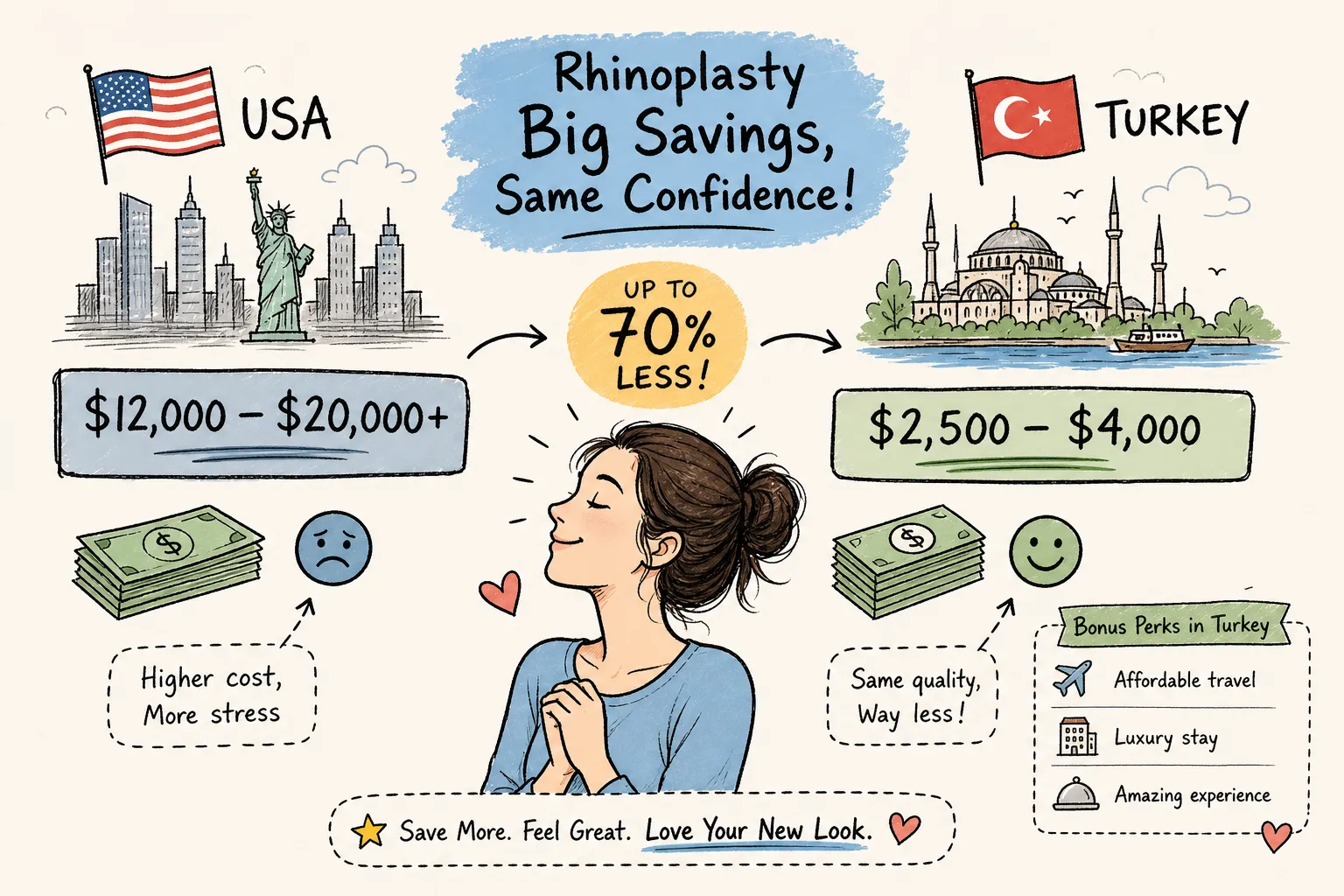
A standard rhinoplasty in the United States routinely costs between $10,000 and $15,000 once all fees are combined. The same procedure, performed by a comparably credentialled surgeon in Türkiye (Turkey), typically costs $3,000 to $5,500. So how much cheaper is rhinoplasty in Turkey compared to the US? In most cases, patients save 60% to 75%, and sometimes more. That gap reflects a structural pricing difference rooted in lower operational overhead, not lower clinical standards, though outcomes vary by clinic tier and provider.
Consider Prof. Dr. Ufuk Bilkay, based in Izmir, as a concrete illustration. He completed his fellowship at Emory University in Atlanta and holds European academic professorship credentials alongside an extensive portfolio of peer-reviewed scientific publications. He operates within Türkiye’s far more competitive pricing environment, which means patients can access a calibre of surgical training comparable to top-tier American institutions at a fraction of the cost those institutions charge. That combination is rarer than the medical tourism industry makes it sound.
This article walks through 2026 price data for both countries, shows how to calculate your realistic net saving, unpacks what Turkish packages actually include, and outlines the credential questions worth asking before you commit to anything.
What rhinoplasty really costs in the US in 2026
Surgeon fees alone are only part of the bill
The figure most commonly cited in American media, the American Society of Plastic Surgeons’ average surgeon fee of around $7,637, is simply the starting point. On top of that, patients pay separately for anaesthesia ($1,000 to $2,000), the surgical facility ($800 to $2,000), and pre-operative tests. When every component is combined, the realistic all-in total for a standard primary rhinoplasty sits between $10,000 and $15,000. Patient-reported data from RealSelf places the nationwide average at approximately $11,880, which aligns with that range.
How location and surgeon reputation drive the price ceiling
Geography creates a wide spread within the US market. Established surgeons in mid-tier cities typically charge $10,000 to $15,000 for a complete package. Double board-certified facial plastic specialists in New York or San Francisco routinely charge $15,000 to $25,000, with the most in-demand practitioners reaching $30,000. The San Francisco Bay Area alone averages $13,000 to $19,500 for comprehensive care. A significant portion of that premium reflects the cost of running a practice in a high-rent, high-liability market, higher overheads, malpractice costs, and regional pricing dynamics, rather than differences in surgical technique alone, and American patients absorb it entirely.
How much cheaper is rhinoplasty in Turkey compared to the US, 2026 figures
The three tiers and what separates them
Primary rhinoplasty in Türkiye in 2026 ranges from roughly $2,500 to $7,500 USD (approximately £2,200 to £5,500 GBP, or €2,500 to €6,800 EUR) depending on clinic tier. Entry-level clinics sit between $2,500 and $3,500 and offer experienced but less specialised surgeons with standard open or closed techniques. Mid-tier and JCI-accredited hospitals fall between $3,500 and $5,500 and typically bundle accommodation, transfers, and advanced approaches such as Piezo ultrasonic rhinoplasty or preservation techniques. High-tier practices featuring professors or internationally credentialled surgeons occupy the $5,500 to $7,500 range and often include luxury hotel stays and dedicated patient coordinators.
Why Türkiye can price this way without cutting corners
The savings patients access in Türkiye are driven by lower overhead, lower malpractice costs, and a favourable exchange rate, not by reduced surgical skill. Many Turkish hospitals hold Joint Commission International (JCI) accreditation, the same standard used to evaluate top-tier hospitals in the United States and across Western Europe. A peer-reviewed study of 4,978 patients published in the Aesthetic Surgery Journal found a major complication rate of 0.7% for experienced Turkish specialists at accredited centres, comparable to Western European and North American benchmarks. That pricing gap is primarily an economics story, lower structural costs in a different healthcare system, though clinical risk does vary by provider and facility tier.
The honest savings calculation: what you actually keep
Calculating how much cheaper rhinoplasty in Turkey is compared with the US
Comparative data from platforms including Whatclinic and Bookimed consistently place rhinoplasty in Türkiye at 60% to 75% below US equivalent pricing, with some all-inclusive comparisons reaching 80% in the most favourable cases. Taking a realistic mid-point: a $12,000 US procedure compared with a $4,000 Turkish package represents a gross saving of $8,000. Add in round-trip flights from a major US hub (typically $700 to $1,200, with seasonal variation) and hotel accommodation for the recovery period ($420 to $700), and your net saving still sits comfortably between $5,500 and $9,000 for most primary rhinoplasty patients. That is not a marginal difference; it is a meaningful sum of money.
What the calculation looks like for revision cases
Revision rhinoplasty makes the financial argument even sharper. In the US, revisions involving scar tissue or structural correction routinely cost $12,000 to $30,000, with the upper end representing specialist facial plastic surgeons in major cities. Turkish pricing for equivalent complexity typically falls between $4,500 and $7,000. Even after factoring in transatlantic travel, the net saving for a revision case can reach $7,000 to $20,000. That proportional saving holds broadly consistent across procedure types, which is why medically literate patients at nearly every complexity level are running the numbers and arriving at the same conclusion.
What a Turkish rhinoplasty package includes (and what to check)
Standard inclusions across reputable clinics
Most mid-tier and premium Turkish rhinoplasty packages bundle a considerable amount into a single quoted price. You can generally expect the surgeon’s fee, operating theatre use, and general anaesthesia, along with one to two nights in a JCI-accredited hospital. Packages also typically include all post-operative medications, the nasal splint, five to seven nights in a four or five-star hotel with breakfast, VIP airport and clinic transfers, a multilingual patient coordinator, and in-Turkey follow-up consultations including splint removal. That is markedly different from the typical US billing model, where surgeon, anaesthesia, and facility fees are usually itemised separately and the patient manages all logistics independently, though some US practices do offer concierge-style services in certain markets.
The exclusions that catch patients off guard
International flights are almost never included and represent the single largest additional cost. Travel insurance, CT scans required pre-operatively, and extended hotel stays beyond the package duration are also typically excluded. The area that warrants the most scrutiny is the revision surgery policy. Some clinics guarantee touch-ups within a defined timeframe; others charge separately for any secondary work. Always request an itemised quotation rather than a headline price, and confirm the revision policy in writing before you commit. A clinic that cannot clearly articulate its revision terms is telling you something important about how it operates.
Safety and credentials: the question that matters more than price
What the data actually shows about complication rates
JCI-accredited Turkish clinics report infection rates below 1%, in line with Western benchmarks for accredited facilities, based on figures including the 4,978-patient Aesthetic Surgery Journal study cited above. The British Association of Aesthetic Plastic Surgeons has, however, flagged a disproportionate share of post-operative complications among patients who chose lower-tier, non-accredited facilities. The peer-reviewed complication data applies specifically to accredited centres with board-certified surgeons. The credential and facility tier you select matters considerably more than the country of surgery itself.
How Prof. Dr. Bilkay closes the credential gap
This is where the standard medical tourism calculation changes. Prof. Dr. Ufuk Bilkay completed his fellowship at Emory University, one of the United States’ most respected academic medical institutions, and holds European academic professorship credentials alongside an extensive record of peer-reviewed publications. For American patients in particular, that academic background addresses the primary concern directly: accessing a surgeon whose training is comparable to that of top US practitioners, at a fraction of the cost.
His clinic in Izmir operates with a full concierge patient journey, including virtual consultations structured around US time zones, pre-operative planning, travel logistics coordination, and a documented post-operative roadmap that continues after patients return home. When comparing a high-tier Turkish practice of this calibre against a comparably credentialled surgeon in the United States, the price difference is substantial. Evidence-based estimates place savings at 60% to 75%, with comparability of outcomes and aftercare depending on provider accreditation, revision policy, and documented follow-up protocols.
The key credential questions to ask any surgeon you shortlist are straightforward:
- Are you board-certified through TPRECD (Turkish Board of Plastic, Reconstructive and Aesthetic Surgery) or an equivalent body?
- Is your surgical facility JCI-accredited, and can you provide the accreditation number for independent verification?
- What is your documented annual rhinoplasty volume, and can you share a portfolio of cases similar to mine?
- What is your revision policy, and is it written into the patient agreement?
Making the decision: how to move from research to a real number
Rhinoplasty in Türkiye is not cheaper because something is missing. It is cheaper because the cost structures of two very different healthcare systems produce fundamentally different price points for the same procedure. In 2026, a well-selected Turkish rhinoplasty delivers a net saving of $5,500 to $9,000 over a US equivalent, even after flights and travel costs are factored in. That figure is consistent across primary and revision cases, and across clinic tiers once you account for what each tier actually delivers.
The variable that determines whether that saving translates into a good outcome is surgeon selection, not geography. Prioritise JCI-accredited facilities, verify credentials independently through official databases rather than relying on clinic websites, and confirm the revision policy before anything else. A surgeon who trained at a rigorous academic institution and maintains an active publication record brings a level of documented experience that is meaningfully different from the broader market, credentials that correlate with surgical volume and clinical rigour, even if no procedure is entirely without risk.
If you want a concrete starting point rather than a broad range, a virtual consultation with Prof. Dr. Bilkay’s team can provide a personalised cost estimate based on your specific nasal anatomy and goals. The consultation is available in English and is structured to accommodate US and UK time zones, making it straightforward to get an accurate number without a lengthy back-and-forth.
Book a Consultation
It’s easy and free!