Travelling to Turkey for cosmetic surgery? This guide covers realistic costs, how to verify your surgeon, recovery timelines, and flying home safely. Plan with confidence.
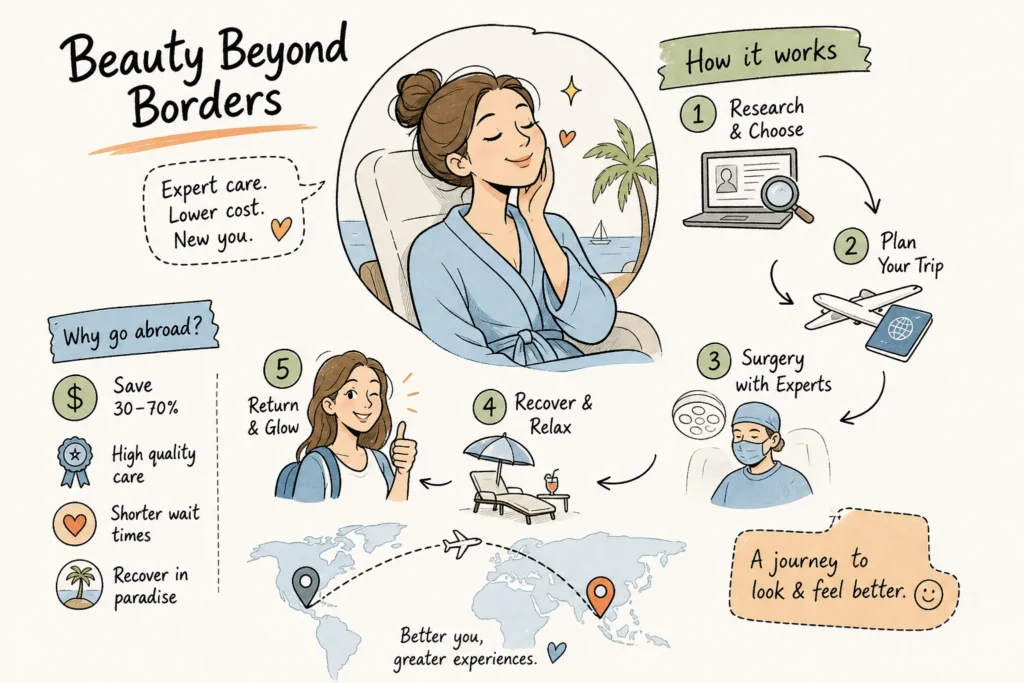
What should I expect when travelling to Turkey for plastic surgery? It is one of the most common questions UK patients ask when they begin researching cosmetic procedures abroad, and it deserves a thorough, honest answer. Turkey has become one of the most searched destinations for plastic and cosmetic surgery among UK patients, and that shift reflects something real: some credentialled clinics in Istanbul and Izmir now offer standards comparable to many UK providers, while the price gap remains substantial. The decision to travel for a surgical procedure requires considerably more preparation than booking a holiday, however. The logistics are manageable, the savings are genuine, and certain well-accredited facilities report outcomes similar to UK centres, though comparative national data remain limited. What separates a transformative experience from a costly complication is almost always the quality of the groundwork done before the flight is booked.
The concerns patients raise most often are entirely legitimate: is it safe? How do I verify my surgeon’s credentials? What happens if something goes wrong once I am home? They are also entirely answerable. This guide walks through every stage of the process, from the first virtual consultation to landing back at Heathrow with a solid recovery plan in place, so that you can make an informed decision rather than a pressured one.
The real costs of plastic surgery in Turkey, and what the quote should include
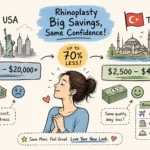
The 40, 70% cost advantage over UK pricing is genuine, and it is not primarily driven by lower standards. It reflects a combination of lower operating costs, favourable exchange rates, and a healthcare infrastructure that has developed specifically to serve international patients. The figures are material: breast augmentation runs £3,200, £5,000 all-inclusive in Turkey against £5,000, £9,000 in the UK (based on 2026 price-comparison data). Rhinoplasty and tummy-tuck prices are often substantially lower, in some sources cited as up to 50, 70% cheaper, though ranges vary and are less consistently documented than breast augmentation figures. For patients who are priced out of domestic options or who face long waiting periods, those numbers represent a credible alternative, not a compromise.
The comparison only holds, though, when you are comparing like for like. A credible all-inclusive package should cover the surgeon’s fee, the clinic or hospital facility costs, anaesthesia, post-operative dressings, at least one follow-up appointment before you fly home, airport transfers, and accommodation. Any quote that omits these items is not all-inclusive; it is a base rate designed to appear competitive, with additional costs appearing at each stage of the booking process.
Patients also frequently underestimate several budget items that fall outside any clinic’s quote. All of these, flights, travel insurance that explicitly covers surgical complications abroad, the cost of extending your stay if recovery takes longer than expected, and the possibility of needing corrective treatment back in the UK, are real figures that belong in your financial planning from the outset. Accounting for them does not make Turkey a less attractive option; it makes your comparison with domestic surgery an honest one.
How to verify your surgeon and clinic before travelling to Turkey for plastic surgery
This is the highest-stakes decision in the entire process, and the statistics make proper vetting non-negotiable. BAAPS reported a 35% year-on-year rise in complications from cosmetic surgery carried out in Turkey (2022 data), with Turkey accounting for 61% of NHS-treated overseas cosmetic-complication cases. That figure does not indict Turkey as a destination; it indicts inadequate due diligence. Many reports and reviews indicate that price is a common driver for patients who later require NHS care, and that the required verification steps were not completed before booking.
Checking surgeon credentials and accreditation
The verification chain for a Turkish plastic surgeon runs through four bodies. The Turkish Ministry of Health practitioner portal allows you to confirm a surgeon’s licence and specialist status using their full legal name and registration number. The Turkish Medical Association (TTB) provides registration confirmation at the national level. Specialty society membership, specifically TSPRAS/TPRECD for plastic surgery, alongside EBOPRAS and ISAPS for international recognition, confirms that a surgeon has met peer-assessed standards within their field. Surgeons who also hold international fellowship training carry an additional layer of credibility that is particularly meaningful for UK patients accustomed to BAAPS and NHS benchmarks. Prof. Dr. Ufuk Bilkay in Izmir, for example, holds an Emory University fellowship, signalling alignment with Western surgical standards and an academic rigour that goes well beyond basic licensing.
For facilities, JCI accreditation is the most internationally recognised marker and can be verified in the official JCI directory. Confirm that the accreditation matches the exact legal entity and location where your surgery will take place, not a sister clinic or a different branch. TÜSKA serves as the domestic accreditation equivalent and is worth checking alongside JCI. The NHS and BAAPS also publish guidance on cosmetic surgery abroad that is worth reviewing before you commit to any provider.
Red flags that should end the conversation
Certain responses from a clinic should end the conversation immediately: pressure to confirm a booking within a limited window; refusal to provide the surgeon’s full name and verifiable credentials before payment; before-and-after images that appear digitally altered; the absence of a pre-operative medical assessment; and package pricing that vaguely bundles “coordinator fees” without clear itemisation. These are not minor inconveniences. They are structural signals about how the clinic operates.
The pre-travel phase: consultations, logistics, and preparation
A legitimate virtual consultation is not a sales call. It should include a full medical history review, a frank discussion of realistic outcomes and their limitations, a clear explanation of your specific surgical plan, and an honest conversation about risks. If the surgeon cannot clearly explain complications, alternatives, aftercare, and total costs during the consultation, that is the moment to reconsider. At Prof. Dr. Ufuk Bilkay’s practice in Izmir, structured virtual consultations are conducted in English before any booking is confirmed, giving patients the opportunity to assess both the surgeon’s communication style and their verifiable credentials before committing to anything.
Clinics that operate a genuine concierge model distinguish themselves sharply in the pre-travel phase. End-to-end support looks like this in practice: a dedicated airport transfer on arrival, pre-arranged accommodation near the clinic, a local contact number available throughout your stay, and a written schedule of all pre-operative and post-operative appointments before you leave home. Clinics that send patients a PDF and expect them to self-manage represent a very different experience, and that difference matters most in the 24 hours immediately after surgery when you are not in a state to solve logistical problems independently.
Before you fly, arrange pre-operative blood tests and GP clearance if you have any comorbidities. Secure travel insurance with a clause explicitly covering surgical complications abroad, this is one of the most commonly overlooked steps in planning going to Turkey for plastic surgery. Share next-of-kin contact details with the clinic in writing, and store copies of all correspondence offline in case of connectivity issues while you are travelling.
Arrival, surgery day, and the first 48 hours
The typical arrival sequence at a well-run clinic involves a transfer directly to accommodation, followed by a pre-operative medical review and anaesthesia consultation on the first or second day. Nil-by-mouth instructions will be communicated in advance. In a JCI-accredited facility, the environment is clinical rather than hospitality-focused, and English-language support at every touchpoint is what separates a professional international patient pathway from one that leaves you navigating alone.
Surgery day follows a standard sequence: admission, marking with the surgeon, anaesthesia induction, the procedure, and the first hours in the recovery suite. The immediate post-operative period is not comfortable. Patients are groggy, often in significant discomfort, and not in a state to process information or make decisions independently. A dedicated post-operative coordinator in those first hours is strongly recommended as best practice. They monitor your early recovery, manage pain communication with the nursing team, and ensure that anything requiring escalation is not missed.
In the 24, 48 hours after your procedure, swelling, bruising, and discomfort are normal rather than alarming. The first dressing check typically occurs within this window. Early mobility guidance, particularly important for DVT prevention, should be provided by the nursing team. You should know before surgery who to contact if something feels wrong and what the clinic’s out-of-hours support protocol is. If no protocol exists, that is information worth having before, not after, your operation.
In-country recovery: how long to stay and what each stage involves
The minimum recommended stay varies significantly by procedure, and booking a return flight before you meet the milestone markers for your specific surgery is one of the most common mistakes patients make when travelling to Turkey for plastic surgery. Hair transplants typically require 3, 4 days. Breast augmentation and liposuction call for 5, 7 days. Rhinoplasty and facelift procedures require 7, 10 days as a minimum. Tummy tucks and combined procedures need 10, 14 days before travel is appropriate. These are not arbitrary recommendations; they reflect the clinical checkpoints that need to be met before you are safe to fly.
Recovery milestones and pre-flight clearance
The key milestones during your stay include a dressing review at days 3, 5, splint or cast removal for rhinoplasty patients at days 5, 7, and suture removal alongside pre-flight surgical clearance at days 7, 10. Clearance should come from the operating surgeon, not a clinic coordinator. That distinction matters because only the surgeon can assess healing at a clinical level and take responsibility for the decision to clear you for travel.
Recovery during your in-country stay is active, not passive. Wound hygiene, adequate nutrition, strict sun avoidance, and recognising early warning signs, such as unusual warmth around the wound site, discharge, or fever, require your attention and are not automatically managed for you. Rest is essential, but so is the light movement your surgical team will advise to reduce clotting risk.
Flying home safely and aftercare back in the UK
DVT risk after cosmetic surgery is real and measurable. Surgery and prolonged immobility both promote clot formation, and flying compounds that risk, particularly on journeys longer than four hours, in line with NHS guidance on post-surgical travel. The practical precautions are straightforward: wear compression stockings, move your legs every hour during the flight, stay well hydrated, and avoid alcohol. Patients recovering from abdominoplasty or combined procedures require the most caution, given the impact of prolonged sitting on healing tissue and circulation. If you are in a higher-risk category, ask your surgeon whether pharmacological DVT prophylaxis is appropriate for your specific situation.
The aftercare plan should be agreed before you leave Turkey, not improvised once you are home. This means a GP appointment booked within 48, 72 hours of arriving back in the UK, a written surgical report from the clinic to share with your GP, and clear escalation contacts from the clinic for the following 4, 6 weeks. Clinics operating a genuine concierge model remain contactable for international patients long after the return flight. Prof. Dr. Ufuk Bilkay’s practice provides English-language post-operative documentation as standard, precisely because the relationship with an international patient does not end at the airport.
If complications develop after you return, the pathway is clear: your GP is the first point of contact for assessment and onward referral, A&E for urgent presentations, and, where the complication is directly related to the procedure, the option of returning to Turkey for follow-up. Travel insurance that covers emergency return travel for this reason is not an optional extra; it is a core component of a responsible surgical plan.
Making the decision with confidence when travelling to Turkey for plastic surgery
Going to Turkey for plastic surgery is a credible, financially sound option for UK patients, provided the preparation is thorough, the surgeon and clinic are verifiably credentialled, and the aftercare plan is in place before the return flight is booked. The gap between a safe, satisfying outcome and a costly complication almost always comes down to the quality of due diligence rather than geography. Many patients report satisfactory outcomes when proper due diligence is followed; however, complication and revision rates for some overseas procedures remain higher in the datasets referenced above, which makes the verification steps outlined in this guide all the more important.
The first step is a conversation with a surgeon who can demonstrate both the credentials and the communication skills to guide you through the process. If you are considering your options, a virtual consultation with Prof. Dr. Ufuk Bilkay’s team is a well-structured starting point: conducted in English, grounded in verifiable credentials, including TSPRAS membership, EBOPRAS recognition, and an Emory University fellowship, and designed to give you the information you need to make a properly informed decision rather than a pressured one. There is no obligation to proceed, and the quality of that first conversation will tell you a great deal about the quality of care that follows.
Book a Consultation
It’s easy and free!