Comparing a facelift in Turkey vs the USA? See 2026 cost breakdowns, surgeon credentials, common techniques and the right questions to ask before you book.
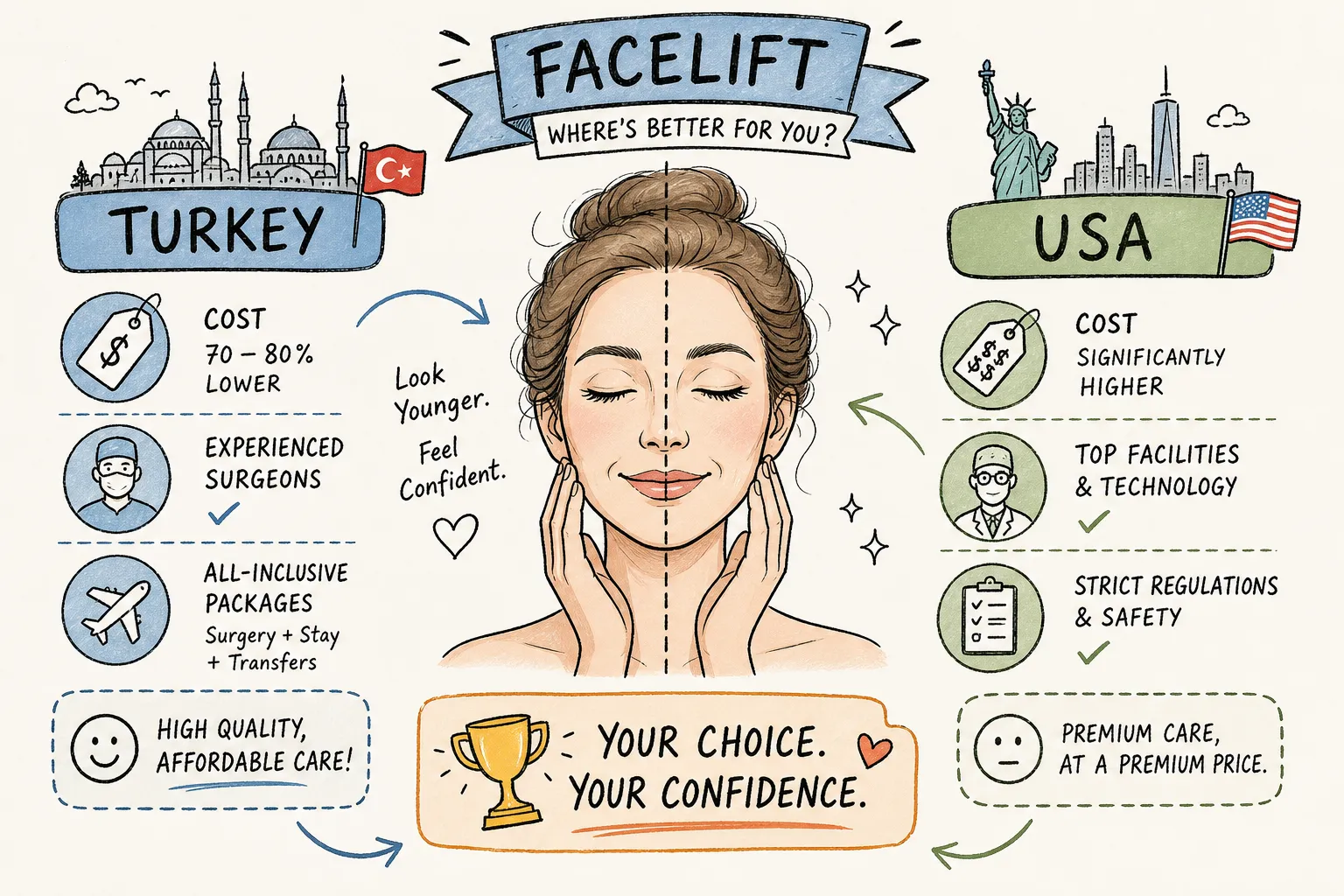
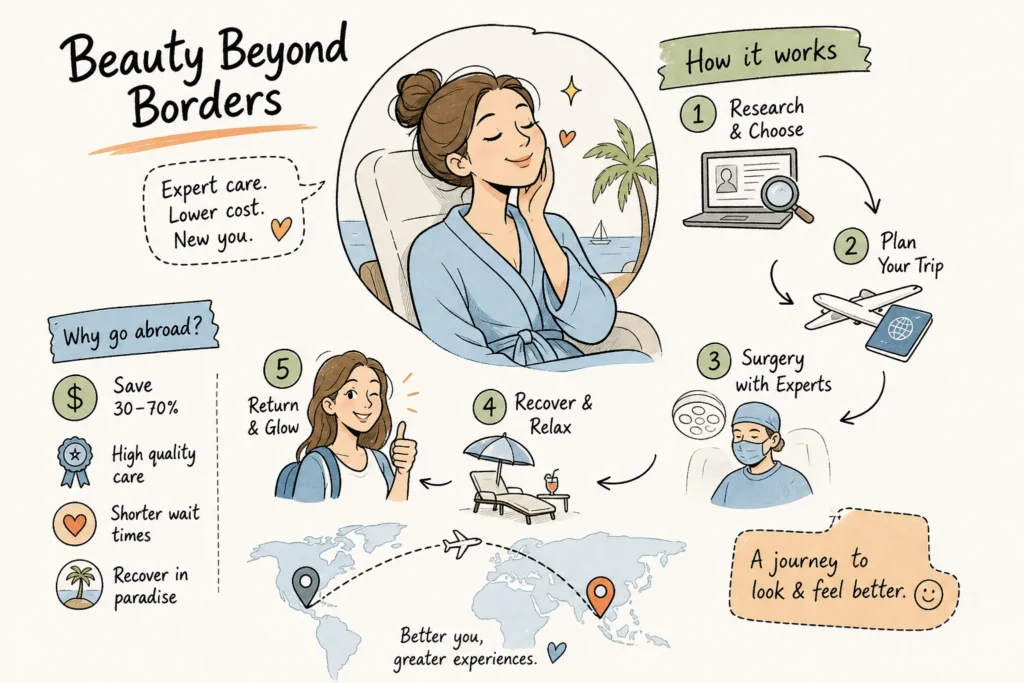
A facelift in Turkey typically costs between £4,500 and £6,500, roughly 60 to 75 per cent less than the same procedure performed in the United States, where out-of-pocket costs for a standard full facelift average £11,500 to £17,000 and can climb considerably higher in major cities. That gap is not an exaggeration circulating on forums. It is documented, consistent across multiple sources, and driven by structural economics: exchange rates, lower clinic operating costs, and Turkey’s deliberately built medical tourism infrastructure.
The concern British and American patients carry into this research is legitimate, though. Cost savings mean nothing if the surgeon is under-qualified or the aftercare collapses the moment you board your return flight. The right question is not “is surgery in Turkey cheap?” The right question is: “Can I access surgeon-level credibility, the kind I would expect at home, alongside the savings?” The answer is yes, but only from a carefully selected subset of practitioners. A small number of Turkish surgeons hold both European academic credentials and advanced training at American institutions, and that combination changes the risk calculation considerably.
This article gives you everything a thoughtful patient needs before making a decision: verified cost data, a clear breakdown of techniques, a practical framework for vetting any clinic you consider, and a realistic picture of what recovery looks like from the operating table to your sofa at home.
What rhytidectomy in Turkey actually costs compared to the USA
The numbers are straightforward. A full facelift in Turkey, including SMAS or deep-plane techniques, typically costs £4,500 to £6,500 in 2026. Premium deep-plane procedures from top-tier surgeons can reach £8,000. In the USA, the total out-of-pocket cost for a standard full facelift averages £11,500 to £17,000 once you combine surgeon fees, anaesthesia, and facility charges. Deep-plane facelifts from high-end practices in cities such as New York or Los Angeles can exceed this range substantially.
The cost difference is not a quality signal. It reflects Turkey’s favourable exchange rate, substantially lower clinic running costs, and a government-backed infrastructure that has positioned the country as one of the world’s primary medical tourism destinations. None of those factors require a reduction in surgical standards.
What an all-inclusive package typically covers is worth understanding before you compare quotes. Standard inclusions are:
- Surgery, general anaesthesia, and operating room fees
- One to two nights in a private hospital room
- Five to seven nights in a partnered four or five-star recovery hotel
- VIP private transfers between airport, hotel, and clinic
- Pre-operative tests, prescribed medications, and compression garments
- A dedicated patient coordinator and English-language support
- Follow-up appointments and suture removal before departure
What packages do not cover: international flights, hotel nights beyond the standard allocation, travel insurance, post-return medications, and visa fees. When comparing quotes across clinics, confirm whether the price reflects a full rhytidectomy or a mini facelift. These are meaningfully different procedures, and the distinction is not always clear in promotional materials. Facelift packages in Istanbul and other major cities vary widely in what they include, so request an itemised breakdown from any clinic before committing.
Facelift techniques available in Turkey: what each one delivers
Understanding the technique options matters for two reasons. It shapes your recovery timeline and your expectations for the result. It also reveals something important about the surgeon: one who recommends the same procedure to every patient regardless of anatomy is a surgeon worth reconsidering.
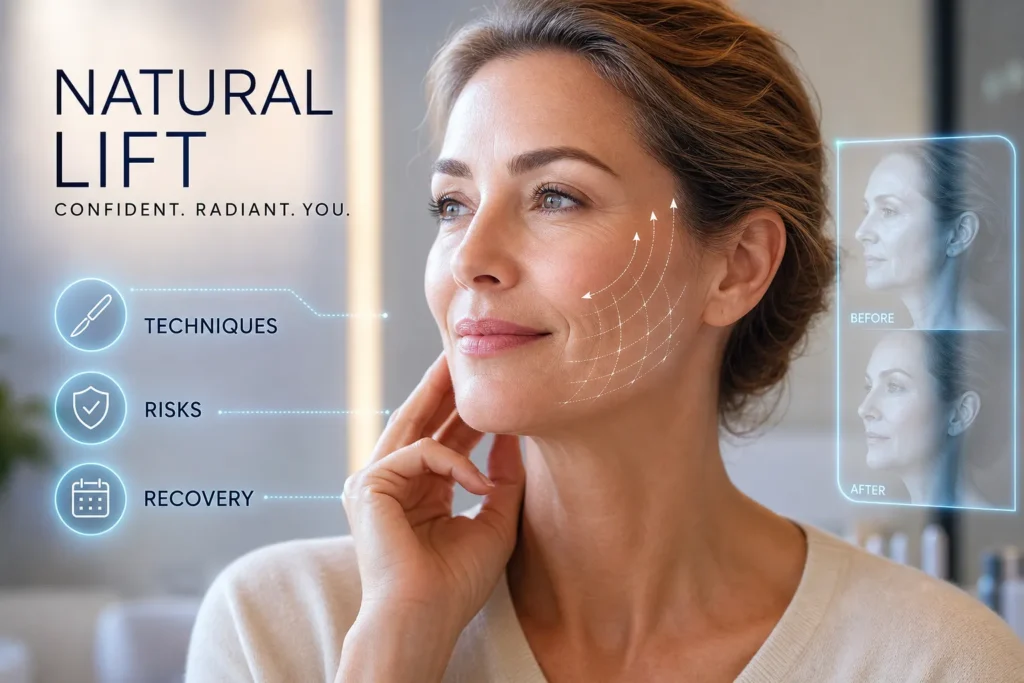
The SMAS facelift repositions the superficial musculoaponeurotic system beneath the skin. It addresses moderate to severe sagging in the mid-face, jawline, and neck effectively, with results typically lasting eight to ten years. Most visible swelling resolves within two to four weeks. This is a proven, widely performed technique across Turkey’s leading clinics.
The deep-plane facelift goes further, lifting the deeper support structures, muscle and fat, as a single composite unit beneath the SMAS. The result is tension-free because the skin itself is not under strain; the underlying architecture has been repositioned. Research published in a 2024 systematic review shows deep-plane patients average a 94.4 per cent satisfaction rate versus 87.8 per cent for SMAS, with results that hold for ten to fifteen years. Many surgeons and researchers consider it the preferred technique for avoiding the “pulled” appearance and for complex facial rejuvenation, though overall complication rates are slightly higher than SMAS (17.2 per cent versus 10.3 per cent in the same review). Notably, rates of skin ischaemia are actually lower because tissue vascularity is better preserved. Operating time is longer, and the technique requires advanced subspecialty training.
The mini facelift uses shorter incisions to target early jowls and mild skin laxity. It suits patients in their forties with minimal neck involvement who want a faster recovery of one to two weeks. It is not a substitute for a full lift where significant neck sagging or mid-face descent is present. If a clinic’s quoted price sits at the lower end of the range and they are recommending this technique without examining your anatomy, ask for clarification on exactly what is being proposed.
Choosing a surgeon for a facelift in Turkey: how to verify qualifications before you book
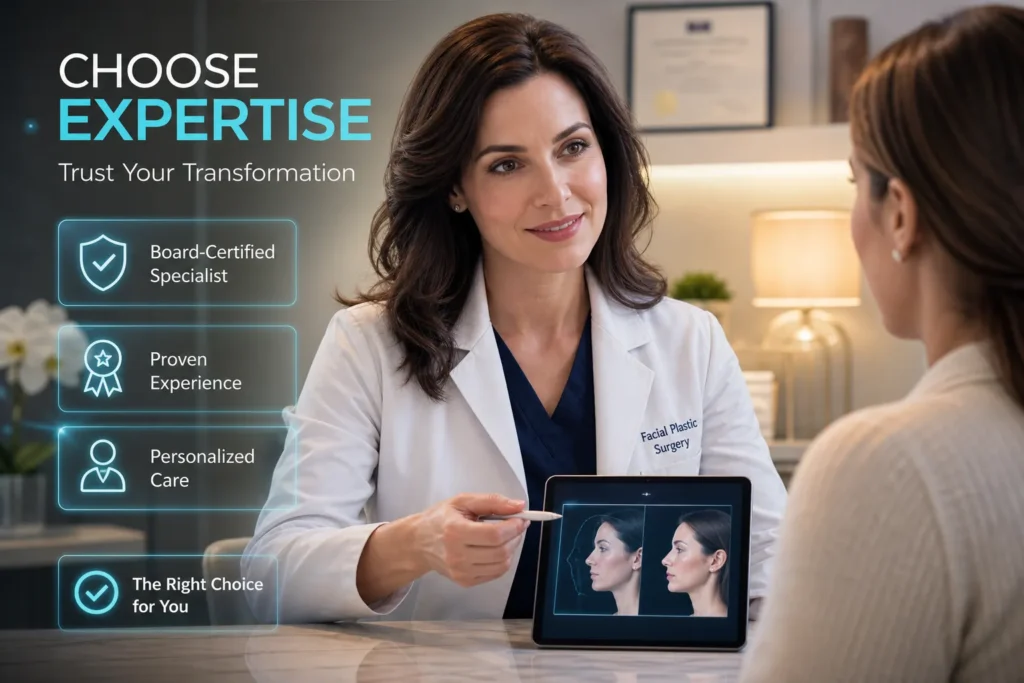
Many patients assume “board-certified” means the same thing in Turkey as it does in the United States. It does not, and understanding the difference is the most important due diligence you will do. The baseline Turkish credential is specialist certification from the Turkish Medical Association (TBB) in Plastic, Reconstructive, and Aesthetic Surgery. This is the mandatory standard required to practise as a specialist in Turkey, and it follows six years of medical school and a further six years of specialised residency, a rigorous training pathway comparable in duration to U.S. programmes.
Above that baseline, look for EBOPRAS certification (European Board of Plastic, Reconstructive and Aesthetic Surgery), which requires passing a written and oral examination administered by an international panel. FEBOPRAS is the fellowship diploma awarded upon passing. ISAPS membership (International Society of Aesthetic Plastic Surgery) signals that the surgeon is board-certified in their home country and active within the global aesthetic surgery community. For the hospital itself, JCI accreditation (Joint Commission International) is the international equivalent of U.S. Joint Commission standards. Verify credentials through the EBOPRAS certified fellows list, the ISAPS Find a Surgeon database, and the hospital’s own credentialing office. A bio page alone is insufficient.
Training at an American institution takes this a step further for U.S. patients. A small number of surgeons practising in Turkey hold advanced training from American academic medical centres, a credential that addresses U.S. patients’ concerns about surgical standards more directly than European certification alone. Prof. Dr. Ufuk Bilkay, based in Izmir, is among this group: a European academic professor with advanced training at Emory University in Atlanta and extensive experience in complex facial rejuvenation, including published contributions to peer-reviewed surgical literature. That combination of American-standard training and European academic credentialing is not the norm in Turkish medical tourism. It is the specific profile that meaningfully closes the credibility gap that makes international patients hesitant.
Questions to ask any Turkish clinic before you commit
A well-qualified surgeon will welcome these questions. Any clinic that deflects or gives vague answers is telling you something important.
On the surgeon and technique: ask where the surgeon completed their specialist training and whether they hold EBOPRAS, ISAPS membership, or any advanced U.S. training credential. Request documentation, not just a bio. Ask how many full or deep-plane facelifts the surgeon has personally performed, and whether you can review verified facelift before and after results from their own patients. Ask which technique will be recommended for your specific anatomy, and why. A credible answer will be individualised. Ask whether the surgeon will perform the entire operation from start to finish, or whether any portion is delegated to a resident.
On aftercare and what happens when you return home: ask what the post-operative follow-up protocol looks like during your stay in Turkey, and what the structured plan is for telemedicine check-ins after you fly home. Ask what the clinic’s protocol is if a complication arises after you have returned to the USA or UK, and who is responsible for coordinating your care. Ask whether a patient coordinator is available throughout your recovery, in your language. Ask whether a virtual consultation is available before you commit, so you can assess the surgeon’s clinical judgement without travelling first.
Recovery after a facelift in Turkey: timelines and what to plan for
Plan to remain in Turkey for seven to ten days. The first one to two nights are typically spent in hospital under nursing supervision. After discharge, recovery continues at the partnered hotel. At days five to seven, you will have your first post-operative appointment for a swelling assessment. Between days seven and ten, sutures are removed and you receive medical clearance before flying.
Expect significant swelling and bruising in the first week. This is normal and does not reflect the final outcome. Facelift results at six months tell a more accurate story than results at two weeks. Deep-plane procedures may involve a more pronounced immediate recovery due to the depth of tissue manipulation, but the longer-term result justifies the additional healing time, according to the research.
After returning home, most patients resume light desk work within two weeks. Strenuous activity should be avoided for four to six weeks. Full resolution of swelling takes three to six months, with scar maturation potentially extending to twelve to eighteen months. Complication rates are low when surgery is performed by credentialled surgeons: haematoma occurs in approximately one to two per cent of cases, and infection is uncommon and manageable with prompt wound care. Reputable clinics schedule telemedicine follow-ups at one week, one month, three months, six months, and one year post-surgery. Confirm this protocol before you book.
Making the right decision: credentials first, cost second
The price difference between a facelift performed in Turkey and one performed in the United States is real, consistent, and significant. But Turkey is not a monolith. Quality is entirely dependent on the individual surgeon and clinic, not on geography. The range of surgical skill and institutional rigour across Turkish clinics is wide, which makes vetting non-negotiable.
The credibility gap that makes international patients hesitant is a legitimate concern, and it is solvable. Look for EBOPRAS or FEBOPRAS certification, JCI-accredited hospitals, ISAPS membership, and, where available, evidence of advanced U.S. training. These credentials are independently verifiable and represent the specific combination that brings Turkish surgical standards into direct alignment with what American and British patients expect at home.
Prof. Dr. Ufuk Bilkay at his Izmir clinic represents exactly this combination: advanced training at Emory University, a European academic professorship, and extensive experience in complex facial rejuvenation for international patients. His practice is built around a full concierge journey, coordinated transfers, a dedicated patient coordinator, English-language support throughout, and structured telemedicine follow-up after you return home. If you are weighing a facelift in Turkey against options closer to home, the most useful first step is a virtual consultation with the surgeon directly. That conversation requires no travel and no commitment, and it will tell you more about clinical judgement and communication than any brochure or before-and-after gallery.
Book a Consultation
It’s easy and free!