Natural facelift results explained: what separates subtle from overdone, how deep-plane, SMAS and mini techniques compare, and how personalised surgery delivers elegant outcomes.
The question every facelift patient carries into their first consultation is not “will this hurt?” or “how much will it cost?” It is simpler and more quietly terrifying than either: “Will I achieve natural facelift results and still look like myself?” The fear of emerging from surgery with a pulled, artificial, or frozen appearance keeps many genuinely good candidates from pursuing a result they deserve. Understood correctly, it is also the most useful question a patient can ask, because a surgeon’s answer reveals their entire philosophy.
A well-executed facial rejuvenation leaves no visible signature of surgery. What it leaves instead is a face that looks rested, harmonious, and recognisably yours. The outcome is not a transformation; it is a restoration. Understanding what separates that kind of result from an overdone one, how different surgical techniques produce it, and how long it holds is the purpose of this guide. At Prof. Dr. Ufuk Bilkay’s clinic in Izmir, this distinction is not a matter of aesthetic preference. It is the foundational principle behind every surgical plan: to honour a patient’s identity, not overwrite it.
What separates natural facelift results from overdone ones
The telltale signs of an overdone facelift
Surgeons who have seen the full spectrum of facelift outcomes can identify excess within seconds. The most consistent marker is lateral tension: the corners of the mouth or eyes pulled sideways rather than lifted vertically, giving the face a stretched, horizontal tightness. This is typically the result of surgery that prioritises skin removal over deep tissue repositioning, creating dramatic short-term change that ages poorly and reads as artificial from the outset.
Other reliable warning signs include hairline displacement, particularly recession at the temples and the disappearance of natural sideburn position, the “pixie ear” deformity, where excess tension causes the earlobe to be pulled downward and tethered to the cheek or jawline, and an overly smooth, waxy complexion that has lost its natural pore structure and texture. None of these is an accident. Each points to a specific surgical choice made under the wrong philosophy.
What genuine naturalness looks like after surgery
The hallmarks of a well-executed result are almost paradoxically quiet. Skin texture and pore structure are preserved. The eyes appear rested without any hint of a startled expression. The jawline has definition rather than a taut, drawn line. There is continuity between the treated and untreated face: no visible boundary where surgical change ends and untouched tissue begins. Photographs taken at different angles and in different lighting look consistent rather than selectively flattering.
This kind of result photographs well precisely because it is not performing. It simply looks like the patient at their best, at a point in time they would choose to be, and that quiet authenticity is the truest measure of success.
Why facial proportions are the surgeon’s compass
Classical facial proportion, specifically the relationship between the midface, jawline, and neck, is not a subjective aesthetic preference. It is a measurable structural framework that guides every surgical decision a skilled surgeon makes. Lifting tissues without accounting for proportional balance is the primary cause of the distorted results patients fear most.
The concept of vector-conscious repositioning addresses this directly. Rather than pulling tissue in the direction that removes the most excess, the technique restores tissue to the position it occupied in youth: a vertical or oblique lift that reverses the actual direction of gravitational descent. The result is a face that looks rejuvenated because the underlying architecture is correct, not merely because the surface is tighter.
How to evaluate before-and-after photos like an expert
Assessing natural facelift results in before-and-after photos
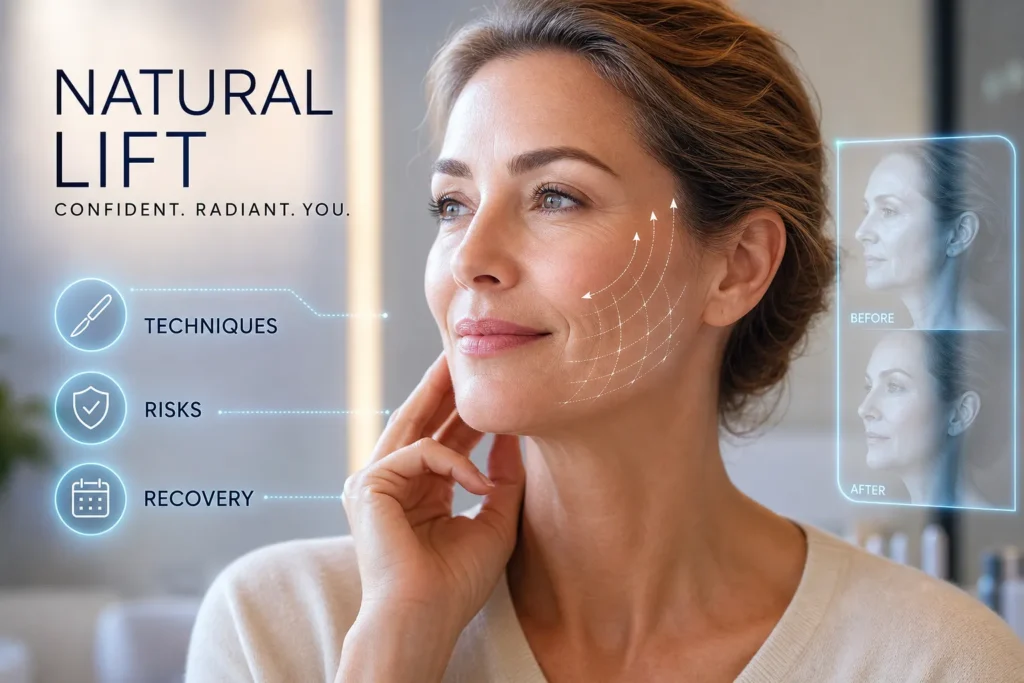
The single most reliable indicator of a surgeon’s actual results is their photographic documentation, but reading that evidence correctly requires a specific eye. Consistent lighting, angle, and focal length across matched pairs is non-negotiable. Any shift in camera distance, head position, or ambient light between before and after shots introduces flattering distortion that obscures the true result. Patients should also look for images taken at meaningful intervals, six months and twelve months post-operatively, not just six weeks when residual swelling may still be masking the final outcome.
A transparent gallery demonstrates a range of ages, skin types, and starting conditions. If every patient in a gallery appears to be between 45 and 55 with similar skin quality and a similarly dramatic result, that is a curated presentation, not a complete picture of a surgeon’s work.
Red flags in a surgeon’s photo gallery
The warning signs worth pausing over are specific. Dramatic transformations that show obvious lateral tension or volume distortion suggest a technique that prioritises impact over accuracy. The absence of long-term follow-up images, particularly at five years or beyond, may indicate a surgeon who does not track outcomes over time. Heavy retouching is identifiable through unnaturally smooth skin texture in post-operative images, the very quality a skilled facelift should not produce artificially. An exclusively youthful or demographically narrow patient cohort suggests selective showcasing rather than honest documentation.
The role of long-term photographic evidence
The true quality of a subtle, natural result reveals itself over years, not weeks. Images at three and six months show whether swelling has settled into a genuinely harmonious outcome. Images at five-plus years answer a more demanding question: does the surgical architecture hold? Deep-plane techniques, which reposition the SMAS layer along with its attached ligaments and fat compartments as a composite unit, show 89% midface lift retention at five years compared to 63% for SMAS plication alone. That data point is what “long-lasting” actually means in clinical terms.
Technique comparison: deep-plane, SMAS and mini facelift outcomes
Deep-plane facelift: the benchmark for natural longevity
Deep-plane surgery operates below the SMAS layer, releasing the zygomatic, masseteric, and mandibular retaining ligaments to reposition the malar fat pads, superficial fascia, and overlying skin as a single composite flap in a vertical vector. This is not merely a technical refinement; it is a fundamentally different approach to ageing anatomy, one that corrects the structural causes of facial descent rather than managing the surface consequences. The result is midface volume restoration, softened nasolabial folds, and a jawline defined by repositioned tissue rather than skin tension.
Approximately 80 to 90% of the final result is visible at three months, with full tissue settlement and scar softening at six months. Published longevity benchmarks place deep-plane results at 10 to 15 years. Transient facial nerve injury rates are 0.69%, lower than the 1.85% associated with high lateral SMAS techniques, with permanent injury below 0.1% across all approaches. Overall patient-reported satisfaction at twelve months is 95 to 99% in peer-reviewed systematic reviews, placing deep-plane as the most consistently well-regarded technique for patients seeking genuinely natural facelift results that endure.
SMAS facelift results: reliable rejuvenation with a familiar recovery
SMAS plication and imbrication address the muscular layer without the extensive ligament release of a deep-plane dissection. These are the workhorses of facelift surgery: technically reliable, widely performed, and capable of producing consistent, high-quality improvement in the right candidate. Longevity benchmarks sit at 10 to 12 years, with a social recovery of one to two weeks and a final result that emerges at three to six months. Overall patient satisfaction is 87.8% in systematic reviews.
Review data does indicate that SMAS results show less midface naturalness at long-term follow-up than deep-plane outcomes, particularly where ligament release makes the critical structural difference. For patients with early to moderate facial ageing and good skin quality, SMAS techniques remain an excellent, evidence-supported choice. The right recommendation depends on anatomy, not hierarchy.
Mini facelift outcomes: who genuinely benefits and what to expect
Consider the patient in their late forties with early jowl formation and mild neck laxity but excellent inherent skin quality, this is precisely the candidate for whom a mini facelift was designed. It is a precision instrument for a specific stage of ageing, not a less invasive version of a deep-plane approach. It addresses a different problem entirely. Social downtime is approximately one week, final results emerge within two to three months, and longevity sits at five to seven years.
The key clinical honesty here is this: a mini facelift cannot replicate the structural repositioning of a deep-plane procedure, and patients who need that level of correction will not achieve it through a limited dissection. In the right candidate, however, it produces a refreshed, natural result precisely because the degree of intervention matches the degree of change required.
Facelift longevity: how long do subtle results actually last
The ten-year question: which technique ages most gracefully
The longevity benchmarks across techniques are: deep-plane at 10 to 15 years, SMAS at 10 to 12 years, and mini facelift at 5 to 7 years. An important nuance applies to all three: results are permanent in the sense that the face ages from a rejuvenated baseline rather than reverting entirely to its pre-surgical state. The clock does not reset to zero; it moves forward from a better starting point. Younger patients, those under 53 at the time of surgery, average 12.4 years before considering revision, compared to 9.3 years for those who wait until more advanced ageing has set in.
Factors that extend and shorten your results
Several variables within a patient’s control have a meaningful effect on how long surgical improvement holds. Daily SPF 50 application is the single most effective protective measure, as UV exposure directly degrades collagen and elastin. Smoking avoidance is equally significant: smokers see noticeable result decline approximately two to three years earlier than non-smokers. Weight stability protects lifted tissue from the stretching or deflation caused by significant fluctuation.
From year three onward, prescription retinoids and collagen-stimulating energy-based treatments, such as radiofrequency microneedling (Morpheus8) and high-intensity focused ultrasound, provide clinically supported maintenance that extends the visible benefit of surgical work. These are not replacements for surgery; they are the ongoing investment that protects it.
Non-surgical alternatives: when surgery is not the right step yet
Not every patient presenting with facial ageing is an immediate surgical candidate, and understanding where non-surgical options sit in the landscape is part of informed decision-making. Treatments such as thread lifts, injectable collagen stimulators, and high-intensity focused ultrasound can address very early laxity and provide modest improvement in patients who are not yet ready for surgery or who have minimal changes. Their results are real but limited: most non-surgical approaches offer one to three years of visible improvement and cannot replicate the structural repositioning that produces natural facelift results in patients with established descent, volume loss, or jowl formation.
The key distinction is anatomical. Non-surgical treatments work at the level of the dermis and superficial tissue; facelift surgery works at the level of the SMAS and its ligamentous attachments. A thorough consultation will clarify honestly which tier of intervention matches a patient’s current anatomy and goals, and at Prof. Dr. Bilkay’s clinic, that distinction is made on clinical evidence, not commercial preference.
The recovery picture: what your face shows week by week
Weeks one to four: swelling, bruising and the first glimpse
Peak swelling and bruising occur within the first 48 hours. By the end of week two, 50 to 60% of swelling has resolved and most patients feel broadly like themselves again for daily home activity. Week three marks social readiness for most patients, with approximately 80% of swelling cleared and contours beginning to emerge. By week four, the face is largely settled and photographically presentable, with 80 to 90% of swelling resolved. More comprehensive procedures such as deep-plane surgery may add two to three days of initial puffiness compared to a mini facelift’s one-week social recovery.
Months three to six: when the genuine result emerges
This is the most clinically significant phase for assessing whether outcomes look genuinely natural. Tissues fully remodel, residual subtle swelling resolves, and scars soften considerably. Patients who form strong opinions about their result before the six-month mark are evaluating an incomplete picture. The face continues refining throughout this entire window, and the outcome at six months is the result that will persist for years.
The natural aesthetics philosophy: Dr Bilkay’s approach to personalised rejuvenation
Harmonious results over dramatic transformation
Prof. Dr. Ufuk Bilkay’s foundational surgical principle is straightforward to state and demanding to execute: the goal of facial rejuvenation is to restore the patient’s own most rested, vital version, never to impose a generic aesthetic template. Over more than 30 years of surgical practice and advanced fellowship training at Emory University in the United States, this philosophy has shaped every dimension of his approach, from technique selection to vector planning to the way pre-operative consultations are structured. The outcome is a face that has returned to itself, with no signature of surgery to identify it as anything other than the patient at their best.
How personalised surgical planning protects facial identity
Surgical planning at Prof. Dr. Bilkay’s clinic begins with detailed facial proportion analysis, assessment of volume loss versus tissue descent, and an honest, evidence-based discussion of what each technique can and cannot achieve for a specific patient’s anatomy. With over 80 published scientific papers informing clinical decision-making, every recommendation is grounded in peer-reviewed evidence rather than trend or intuition. Virtual consultations allow international patients to establish clarity and trust well before they travel to Izmir, ensuring that expectations are calibrated accurately from the outset.
Choosing a surgeon whose philosophy matches your expectations
Before committing to any surgeon, the evaluative conversation matters as much as the credentials on the wall. Ask to see long-term before-and-after images: not just three-month photos, but results at one year and beyond. Understand precisely which technique is being recommended and, more importantly, why it is right for your specific anatomy. Listen to whether the surgeon’s language centres on identity-respecting restoration or on a standardised transformation applied regardless of individual structure.
For patients seeking results that look and age naturally, delivered with academic rigour and a full concierge patient journey, Prof. Dr. Bilkay’s clinic in Izmir offers a credibility-first destination that does not compete on price. It competes on outcomes.
Final thoughts: the result you actually want
Subtle, natural facelift results are not accidental. They are the direct consequence of a surgeon’s philosophy, the technique chosen to match a patient’s specific anatomy, and a commitment to proportional, identity-respecting planning that begins long before the first incision. The difference between a result that ages gracefully and one that betrays itself under any lighting comes down to whether deep structural repositioning guided the plan, or whether surface tension did.
The longevity benchmarks are real and plannable: 10 to 15 years for deep-plane work, 10 to 12 for SMAS, five to seven for mini facelift approaches, all from a rejuvenated baseline that never fully reverts. Evaluate before-and-after evidence at long-term intervals, listen carefully to how a surgeon frames the goal of surgery, and bring the right questions to your consultation. You now have the clinical vocabulary to ask them.
If you are ready to explore your personal candidacy with a surgeon whose entire practice is built around natural, evidence-based outcomes, a virtual consultation with Prof. Dr. Ufuk Bilkay is the clearest next step, that conversation is where it begins.
Book a Consultation
It’s easy and free!