Preserve breast augmentation in Turkey explained: the Motiva technique, costs, recovery, and how to choose a credentialed surgeon. Start here before booking.
Patients researching preserve breast augmentation in Turkey in 2026 are asking sharper questions than they were five years ago. They want to know not just which implants are used, but how the pocket is created, what happens to their supporting tissue, and whether the result will still look natural a decade from now. The Preservé technique, often searched as “preserve breast augmentation”, was developed by Motiva to answer those questions with a fundamentally different surgical philosophy: tissue is displaced rather than dissected, and supporting structures are left intact rather than severed.
That shift in approach has made tissue-preserving breast augmentation one of the most sought-after procedures among patients travelling to Turkey from the UK and the United States. Significantly lower costs than domestic pricing, combined with access to surgeons holding genuine technical credentials, create a compelling proposition. What matters, however, is finding a surgeon whose training and philosophy are well matched to what this procedure demands. Fellowship-trained surgeons in Izmir and Istanbul, including those with credentials from institutions such as Emory University, are raising the standard for what international patients can reasonably expect from an advanced cosmetic procedure abroad.
The following sections cover how the Preservé method works, whether you are a suitable candidate, what the clinical data shows, how to budget and plan for the procedure in Turkey, and how to identify a surgeon who is qualified to perform it.
What the Preservé technique actually involves
Conventional breast augmentation creates an implant pocket through electrocautery or sharp dissection, cutting through the circummammary ligaments that provide the breast’s internal scaffolding. The Preservé technique takes a fundamentally different approach: a channel separator moves tissue laterally while an inflatable balloon gently stretches the space open, leaving those supporting structures fully intact. The result is a pocket created through displacement rather than destruction.
Because the technique places implants above the muscle (subglandular), it eliminates the muscle elevation required by submuscular approaches. Incisions are typically 2.5 to 3 cm, compared to approximately 4 cm in traditional procedures, and many cases can be performed under light sedation rather than full general anaesthesia. Both factors contribute to a meaningfully faster recovery.
Why ligament preservation changes the long-term result
The intact circummammary ligaments continue providing natural internal support after surgery. According to Motiva’s published clinical white paper on the Preservé system, the approach records a 0% rate of inferior malposition at three years. Implant migration is one of the primary reasons patients seek revision surgery, so this outcome directly affects the technique’s long-term value. Preservation of the nerve supply also supports nipple sensation retention, though incision placement remains the dominant variable, a point addressed in the outcomes section below.
The role of Motiva Ergonomix2 implants in the system
Preservé is not simply a surgical technique that can be applied with any implant. It is a proprietary system requiring Motiva Ergonomix2 implants, a SmoothSilk micro-textured surface, and single-use instrumentation. One of the more striking clinical findings from Motiva’s data is that a 215 cc Preservé implant can project volume comparable to a 315 cc conventional implant, because preserved tissue tension works with the implant rather than against it. For patients seeking natural-feeling breast implants with a proportional enhancement rather than a dramatic size change, this is a significant practical advantage.
Preserve breast augmentation in Turkey: who is a suitable candidate?
The Preservé technique is strictly for first-time breast augmentation. It is not a revision option, and it is not suitable for patients with existing implants. Those with significant ptosis requiring a full mastopexy combined with a new implant, or those with complex anatomical asymmetry, may also fall outside the eligible group. The ideal candidate has adequate breast tissue to work with, firm skin with good elasticity, and a defined inframammary fold with a nipple-to-fold distance of roughly 5 to 7 cm.
Physical and lifestyle criteria that make someone a strong candidate
The typical Preservé patient is slim to moderately framed, often athletic, and seeking a subtle increase of one to two cup sizes rather than a conspicuous transformation. Because the technique achieves strong visual results from smaller implants, it is particularly well suited to patients who prioritise proportional, identity-respecting outcomes. The lighter anaesthesia requirement and faster recovery also make it practical for patients travelling from abroad who have a defined window before their return flight. Grade 0 to Grade 1 ptosis is the threshold; anything beyond that requires a different surgical conversation.
Why revision patients need a different surgical conversation
If you have previously had breast augmentation and are seeking an improvement, Preservé is not the appropriate path. Revision surgery involves a fundamentally different anatomical environment where the supporting structures have already been altered. A surgeon of genuine academic calibre will be transparent about this distinction during consultation rather than offering Preservé as a universal solution. If a surgeon presents it otherwise, that response tells you something meaningful about their approach to patient selection.
What the clinical data says about safety and outcomes
The decision to choose tissue-preserving augmentation over conventional methods should be grounded in evidence. Capsular contracture at Grade III or IV occurs in 5% to 15% of patients with traditional implants over ten years. With Motiva implants, the five-year rate sits between 0.5% and 2.1%, a reduction of roughly 90% compared with implants from other major manufacturers. Implant rupture at five years is 0.6% with Motiva versus 10% to 16.5% for conventional devices at ten years. There are zero reported cases of BIA-ALCL associated with Motiva implants, a documented risk with traditional textured surfaces.
Capsular contracture, rupture and the five-year satisfaction benchmark
Capsular contracture is the complication that matters most to prospective patients, and the SmoothSilk surface reduces the inflammatory response that drives it. Motiva’s five-year clinical data shows a 97% patient satisfaction rate and a reoperation rate of 8.8%, roughly half the historical rate for FDA-approved silicone implants from other manufacturers. Choosing a premium system with lower revision rates is not simply a quality decision; it is also a sounder long-term financial one, because it reduces the likelihood of a costly corrective procedure further down the line.
Sensory outcomes: what the evidence actually supports
Nipple sensation outcomes correlate more strongly with incision placement than with the Preservé technique itself. An inframammary (crease) incision carries approximately a 5% risk of sensation change; a periareolar incision carries roughly three times that risk. Because Preservé is typically performed via the inframammary approach, sensation preservation is a reasonable expectation for most patients. A qualified surgeon will explain clearly that it is the incision choice driving that outcome, not the technique in isolation.
Preserve breast augmentation in Turkey: costs and recovery
All-inclusive Preservé packages in Turkey in 2026 typically range from €8,000 to €10,000, equivalent to approximately £7,000 to £9,000. This is considerably higher than standard breast augmentation packages in Turkey, which typically range from €3,400 to €5,500. That price difference reflects the premium Motiva Preservé implant system, single-use proprietary instruments, and the Motiva warranty programme. International flights are not included in package pricing.
Standard inclusions in a well-structured Preservé package typically cover the following:
- Surgeon and operating room fees
- Motiva Preservé implants with proprietary instrumentation
- Anaesthesiologist fees
- Two nights’ hospitalisation at a JCI-accredited facility
- Post-operative garments and medications
- Follow-up consultations
- Five to seven nights in a four or five-star hotel
- VIP airport transfers
Before accepting any quote, confirm explicitly that the Motiva warranty and single-use instruments are included. These are the primary value drivers that justify the premium price point, and their absence from a lower quote is a meaningful red flag.
Recovery timeline and what to expect before flying home
Recovery from Preservé augmentation follows a predictable progression that suits travelling patients well. Most are back to light desk work within three to seven days, with gentle walking encouraged from day one. Low-impact activity is typically cleared at one to two weeks, while full gym clearance, including lifting, comes at four to six weeks. Discomfort is mild to moderate and generally manageable with over-the-counter pain relief by the end of the first week.
The standard follow-up protocol before departure includes a day-one assessment, a swelling check at day three or four, and a pre-departure clearance at day six or seven. Remote follow-up via photographs or video call is then conducted at two weeks and again at six weeks. Before leaving Turkey, your surgeon should provide a digital Motiva warranty card, an operative report, and written aftercare instructions. These documents are not optional, they are the foundation of your post-operative care and warranty coverage once you return home. UK patients should also confirm that their GP or a local private clinic is aware of the procedure, to facilitate any follow-up care needed on home ground.
How to choose the right surgeon for preserve breast augmentation in Turkey
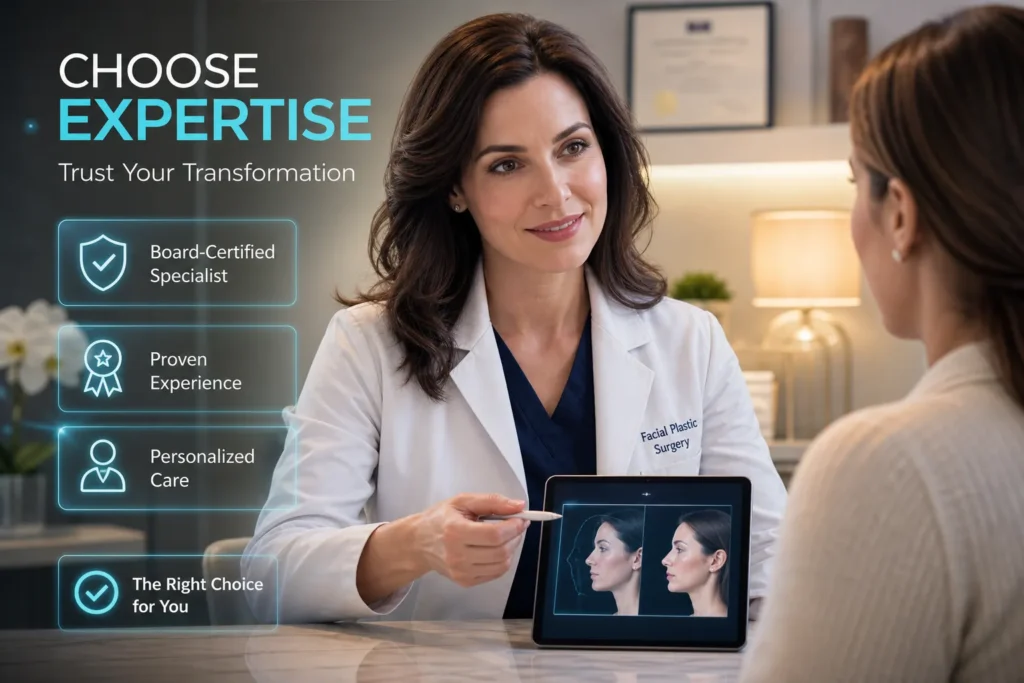
Because Preservé is a proprietary technique requiring specific training authorised by Establishment Labs, not every plastic surgeon in Turkey is qualified to perform it. Motiva Preservé certification is the minimum technical threshold. Beyond that, the relevant criteria include the surgeon’s academic background, the facility’s JCI accreditation status, published outcomes, and the quality of communication during consultation.
Any surgeon who cannot answer direct questions about complication rates, candidate eligibility, or incision logic is not the right choice for a procedure this nuanced. Ask directly whether they hold Motiva Preservé certification. Ask which facility the procedure takes place in and verify JCI accreditation independently through the Joint Commission International directory. Ask to see before-and-after documentation for patients with a similar starting anatomy. Ask what the protocol is if a complication arises after you return home.
Credentials and questions to bring to your consultation
A well-credentialled surgeon with a concierge-oriented practice will have clear, specific answers to all of the above, along with a structured remote communication protocol to support international patients after they leave. If answers are vague, or if the consultation moves quickly past eligibility criteria, treat that as a warning sign. The willingness to discuss candidacy limitations openly, including telling a patient that Preservé is not right for their anatomy, is one of the clearest markers of clinical integrity.
Why Prof. Dr. Bilkay’s training and philosophy are particularly well matched to this technique
The Preservé technique demands anatomical precision, sound intraoperative judgement, and a commitment to natural outcomes. These are not qualities that can be acquired through certification alone; they are built over decades of surgical practice and academic engagement. Prof. Dr. Ufuk Bilkay, based in Izmir, holds both a European academic professorship and a fellowship from Emory University in the United States, one of the most respected plastic surgery training programmes globally. His approach to natural aesthetics, prioritising harmonious, proportional results over dramatic transformations, aligns directly with what tissue-preserving augmentation is designed to achieve.
For patients travelling from the UK or the United States, his Emory University credentials offer a recognisable Western-standard benchmark. His concierge patient journey, which includes virtual consultations, end-to-end logistics coordination, and structured post-operative follow-up, ensures that the practicalities of travelling to Turkey for a specialised procedure are managed with the same rigour as the surgery itself.
Making a well-informed decision before you book
Tissue-preserving breast augmentation in Turkey is not simply a cost-driven decision. It is a decision about accessing a specialised technique from a surgeon with verified certification, an accredited facility, and a clinical philosophy that matches the procedure’s demands. The evidence base is substantial: lower complication rates, a 97% five-year satisfaction rate, and a reoperation rate roughly half that of conventional implants make this one of the most well-documented advances in breast augmentation surgery.
If you are considering preserve breast augmentation in Turkey, the quality of the surgeon and the environment in which they work will determine your outcome far more than the technique alone. For patients seeking Western-standard surgical rigour alongside the value and concierge experience that Turkey can offer, the natural first step is a virtual consultation with a surgeon whose credentials and philosophy are well matched to what this procedure requires. A consultation with Prof. Dr. Ufuk Bilkay offers the opportunity to assess your anatomy, discuss your goals, and establish clearly whether the Preservé approach is the right choice for you.
Book a Consultation
It’s easy and free!