Breast augmentation explained for UK patients: implant types, realistic costs, risks, recovery timelines and how to find a properly credentialled surgeon. Read before you book.
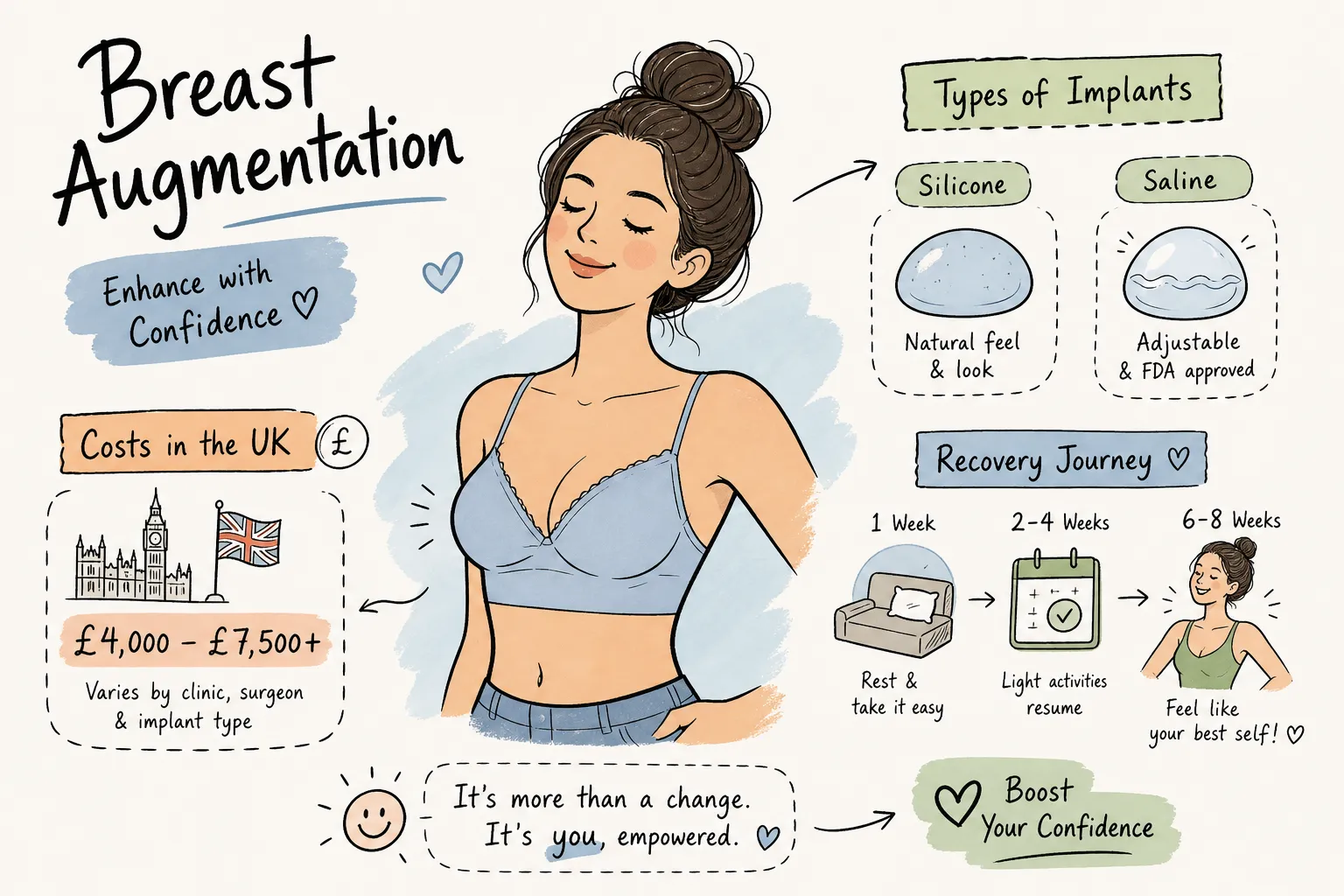
Breast augmentation is one of the most commonly researched cosmetic procedures in the UK, yet most patients arrive at their first consultation having waded through conflicting information: contradictory before-and-after claims, price quotes that bear no resemblance to the final invoice, and recovery timelines that range from “back to work in three days” to “six weeks on the sofa.” The confusion is understandable, and it costs people both money and peace of mind.
This guide cuts through that noise. By the end, you will understand which implant type suits your anatomy, what an honest all-inclusive cost actually covers, how recovery unfolds week by week, and precisely how to verify that a surgeon’s credentials are genuine rather than self-awarded. As more patients extend their search beyond their postcode and consider internationally trained specialists, surgeons such as Prof. Dr. Ufuk Bilkay, who holds Emory University fellowship credentials and has over 30 years of published surgical practice, represent the kind of evidence-based rigour that discerning patients rightly seek out. No hype, no guarantees: just a clear framework for a well-informed decision.
Who is a good candidate for breast augmentation?
The baseline criteria are straightforward. Breast development should be complete before surgery is considered; silicone implants are generally recommended for those aged 22 and over, in line with widely accepted clinical practice, while saline implants may be considered from 18. Patients should be at a stable weight, free from active breast disease, and either non-smokers or genuinely committed to quitting before surgery. BMI thresholds, a review of medications such as anticoagulants or hormone therapy, and a thorough psychological assessment all form part of a responsible pre-operative evaluation, though the specific criteria vary between clinics and should be confirmed directly with your surgeon.
Many surgeons recommend waiting until after childbearing, not because operating earlier is medically catastrophic, but because pregnancy and breastfeeding can change breast tissue substantially and may increase the likelihood of future revision. Framing this as a long-term investment helps clarify why timing matters: a procedure performed at the right life stage tends to require far less correction later.
For patients who want a modest volume increase without implants, fat transfer breast augmentation, clinically termed augmentation mammoplasty via fat grafting, is a legitimate option rather than a consolation prize. Candidacy depends on having sufficient donor fat, typically from the flanks, thighs, or abdomen. Results are modest: comparative studies suggest an increase of around half a cup rather than dramatic enlargement, and patients should expect 20 to 40 per cent reabsorption of transferred fat over six months, which is factored into surgical planning from the outset.
Silicone vs. saline: understanding your implant options
Silicone implants
Approximately 85 per cent of patients choose silicone, and the reason is straightforward: cohesive silicone gel closely replicates the texture and movement of natural breast tissue. Rippling is less visible, the average lifespan is longer (typically 20 to 40 years), and the feel is particularly well-suited to patients with less natural breast tissue. The key management consideration is that silicone does not deflate visibly if it ruptures. Some manufacturers and clinicians recommend an MRI at three years post-surgery, then every two years thereafter; it is worth noting that routine radiological surveillance is not universally mandated by the NHS or NICE, so patients should discuss monitoring plans with their surgeon directly.
Saline implants
Saline implants deserve an honest rather than dismissive assessment. If they rupture, the deflation is immediate and unmistakable, the body absorbs the sterile saline harmlessly, and the upfront cost is lower. The trade-offs are a firmer feel, a higher propensity for visible rippling in patients with thin skin or minimal natural tissue, and a shorter average lifespan of 10 to 20 years. For patients who prioritise simplicity in monitoring and a lower initial outlay, saline is a rational choice.
Shell type and placement
Beyond fill material, several additional decisions shape the surgical plan. Round versus anatomical (teardrop) profiles affect silhouette. Smooth versus textured shells affect long-term risk: textured implants carry a higher association with BIA-ALCL, a rare but treatable lymphoma, and many surgeons now favour smooth-shell devices for primary augmentation due to this association. Submuscular placement generally reduces capsular contracture rates compared to subglandular placement, though it involves a longer recovery and introduces the possibility of animation deformity when the chest muscle flexes. These are anatomically driven decisions made jointly with the surgeon, not a matter of personal preference alone.
What breast augmentation actually costs in the UK
A comprehensive all-inclusive package from a standard UK clinic currently runs between £4,500 and £8,000. For a consultant plastic surgeon, that range rises to £7,000 to £10,000. London clinics typically price 10 to 15 per cent higher than the national average. A legitimate quote should cover the surgeon’s fee, the anaesthetist’s fee, theatre costs, the implants themselves, pre-operative tests, and post-operative follow-up appointments. If a quote does not itemise all of these, ask why.
The more important issue is what a low quote does not tell you. “Starting from” prices frequently reflect hospital charges only, with surgeon and anaesthetist fees billed separately and consultation fees of £150 to £200 added on top. More critically, they say nothing about what happens if something goes wrong. Capsular contracture revision, implant replacement after rupture, or corrective surgery after a substandard outcome all carry significant costs of their own. The cost of breast augmentation in the UK should be evaluated as the full cost of ownership across the implant’s lifespan, not just the day-one invoice. A surgeon priced £2,000 lower whose patients experience higher revision rates is not the more affordable option in any meaningful sense; treat that figure as a cautionary consideration rather than a guarantee of correlation.
Risks and complications: what the data actually shows
Capsular contracture, where scar tissue tightens progressively around the implant, is the most common long-term complication and the primary driver of reoperation within four years. Overall rates sit at roughly 10 per cent, but the published range is wide: 2.4 to 18.9 per cent for primary augmentation, depending on implant type, placement, and surgical technique. Baker Grade I and II contracture is manageable; Grade III and IV typically requires intervention. Submuscular placement and smooth-shell implants are consistently associated with lower rates, which is why placement decisions carry real clinical weight.
Silicone rupture rates reach approximately 9.8 to 24 per cent at ten years depending on the implant brand; saline rupture is more immediate and obvious. BIA-ALCL remains rare, affecting fewer than one in 1,000 patients and primarily linked to textured implant shells. It is highly treatable when caught early. Breast Implant Illness, a reported cluster of systemic symptoms including fatigue, joint pain, and cognitive fog, remains under active clinical study with no current NHS or NICE diagnostic pathway; patients experiencing these symptoms are advised to consult their GP to rule out other causes first. Haematoma occurs in roughly one to three per cent of cases; infection in under one per cent. Approximately 15 to 30 per cent of patients require some form of revision surgery across the implant’s lifespan.
A surgeon’s experience, implant selection rationale, and post-operative monitoring protocol all directly influence where a patient’s personal risk lands within those published ranges. Complication rates are not fixed facts; they are partly a function of the hands performing the procedure and the follow-up rigour that accompanies it.
Breast augmentation recovery: a realistic week-by-week timeline
Days one to fourteen
Days one to three involve manageable discomfort. Movement is encouraged early to reduce clot risk, but driving is off the table for at least 10 to 14 days. Pain typically subsides noticeably by the end of the first week, and non-dissolvable stitches are removed at the one to two week mark. Most patients return to desk-based work within that same window. The compression bra is worn around the clock from day one, and sleeping on your back with the upper body elevated is essential. You may shower 48 hours after surgery; avoid submerging wounds, baths, swimming pools, hot tubs, until your clinic confirms that healing is complete, and follow your surgeon’s specific wound-care instructions throughout.
Weeks two to six
Running, gym sessions, and heavy lifting are restricted until the six-week mark. This restriction reflects the documented risk of implant displacement under premature mechanical load, it is not an arbitrary precaution. Housework and carrying anything substantial are off limits for at least two weeks. A high-protein, low-sodium, alcohol-free diet supports tissue repair during this period. The six-week follow-up with your consultant is a formal clinical checkpoint, not an optional courtesy call.
Months two to six and beyond
Implants settle and soften progressively from week six through to three to six months post-surgery. Final aesthetic results are only fully visible several months after the procedure, which means before-and-after comparisons taken at six weeks misrepresent the actual outcome. Scars continue maturing for up to 12 to 18 months. For silicone implants, an MRI or ultrasound at three years post-surgery and every two years thereafter is advised by many clinicians to monitor implant integrity, confirm the recommended schedule with your surgeon.
How to verify a surgeon’s credentials before you commit
The non-negotiable starting point is the GMC Specialist Register under “Plastic Surgery.” Basic GMC registration is not sufficient; any licensed doctor can technically perform cosmetic procedures in the UK. Verify BAAPS or BAPRAS membership through their public directories, and confirm the clinic holds CQC registration specifically for Surgical Procedures, the category that legally covers breast augmentation in England. FRCS (Plast), denoting Fellowship of the Royal College of Surgeons with a plastic surgery specialisation, and a current or previous NHS consultant post both add meaningful layers of accountability to your verification.
At consultation, the questions that matter most are specific rather than general: How many times have you performed this exact procedure? What is your personal complication rate? Can I see before-and-after photographs of patients with comparable anatomy to mine? Who administers anaesthesia and what are their qualifications? What is the process and cost structure if I am unhappy with the outcome? Who is my clinical contact after discharge and what are their response hours? A surgeon who answers these questions with clarity and transparency is demonstrating precisely the standard that responsible surgical care demands.
For patients considering breast augmentation with internationally trained surgeons, the credential benchmark deserves equal scrutiny. Prof. Dr. Ufuk Bilkay, based in Izmir, completed his fellowship training at Emory University and has accumulated over 30 years of surgical practice supported by more than 80 published academic papers, a verifiable record of academic accountability that goes well beyond volume-based marketing. Whether you choose to operate in the UK or abroad, the operative question is the same: does your surgeon’s training, publication record, and post-operative support structure reflect the rigour you would expect from a university-level specialist?
Making your decision with confidence
Breast augmentation, performed by a properly credentialled surgeon in a CQC-registered facility, is a safe and well-studied procedure. The variables that separate a satisfying long-term outcome from a costly revision are real and documented, which is precisely why understanding them before booking protects you far better than reviewing them afterwards.
The practical checklist is short but non-negotiable: confirm GMC Specialist Register status under Plastic Surgery, obtain a fully itemised quote before comparing prices across clinics, ask specific questions about complication and revision rates during consultation, and treat the breast augmentation recovery timeline as a genuine commitment rather than a loose guideline. For patients exploring options beyond the UK, internationally trained surgeons who hold both European academic credentials and US fellowship qualifications offer a compelling alternative, provided those credentials are fully verifiable and the concierge support around the journey is genuinely comprehensive.
The most important step is not booking the surgery. It is booking the right consultation, with the right questions prepared, and a clear understanding of what a credentialled answer actually looks like.
Book a Consultation
It’s easy and free!